A Net of Lace: The Cartouche Grid and the Longing for a Western Salon
1. A 'Lace Net' Pattern Woven from Cartouches This wallpaper begins by printing tiny oval dots densely onto a pulp paper ground, imitating the texture of a fine woven fabric. Over this, a diamond…
1. A 'Lace Net' Pattern Woven from Cartouches
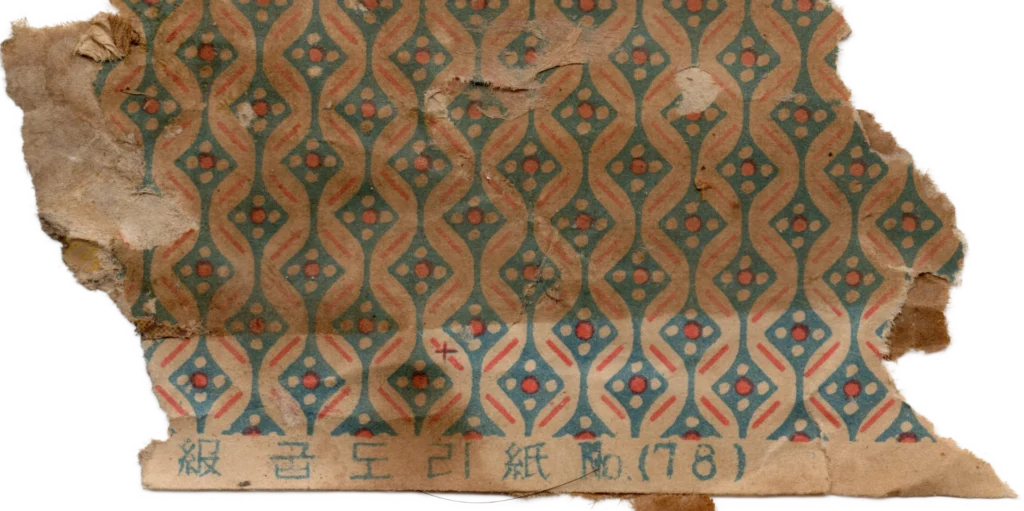
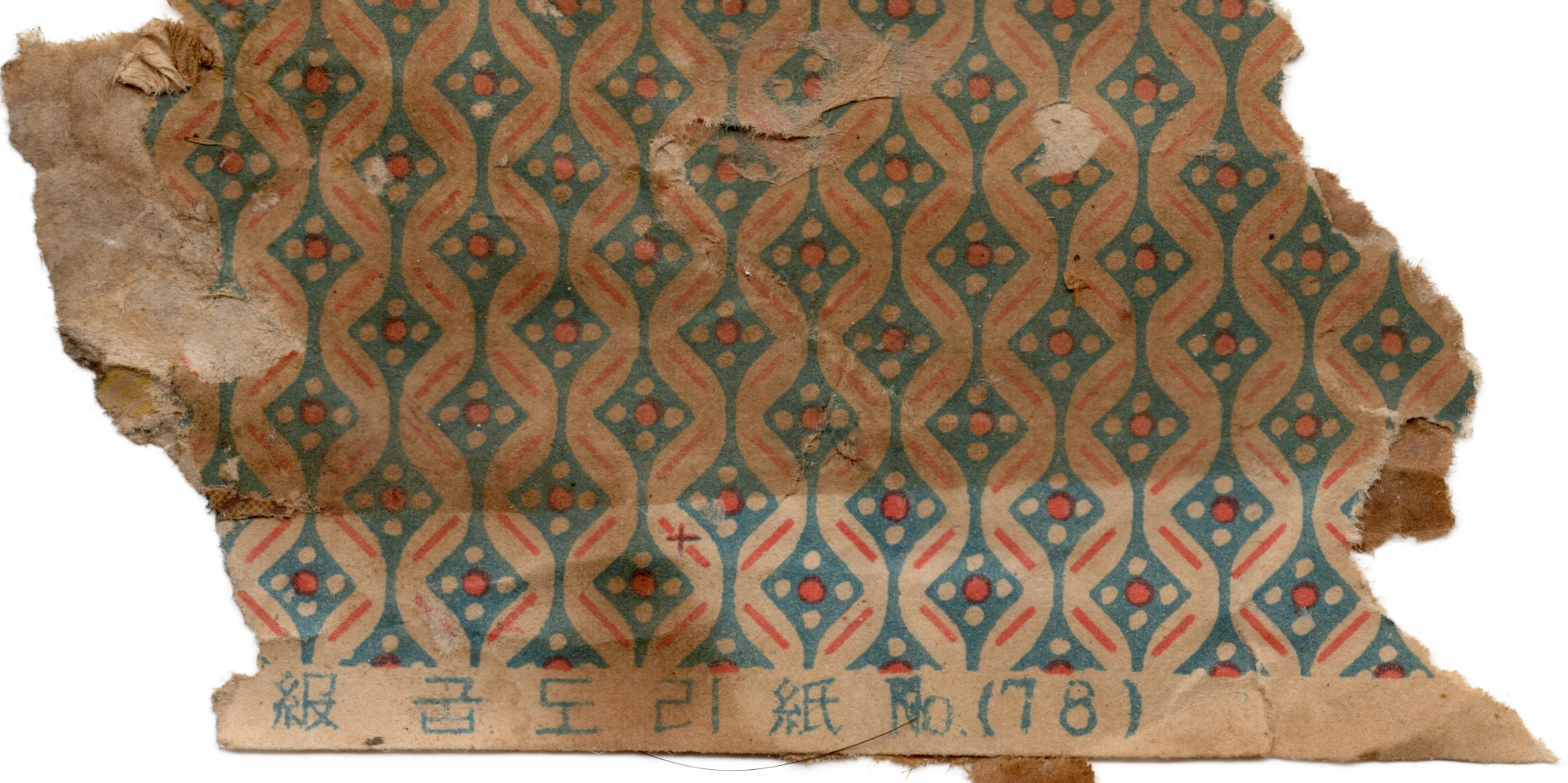
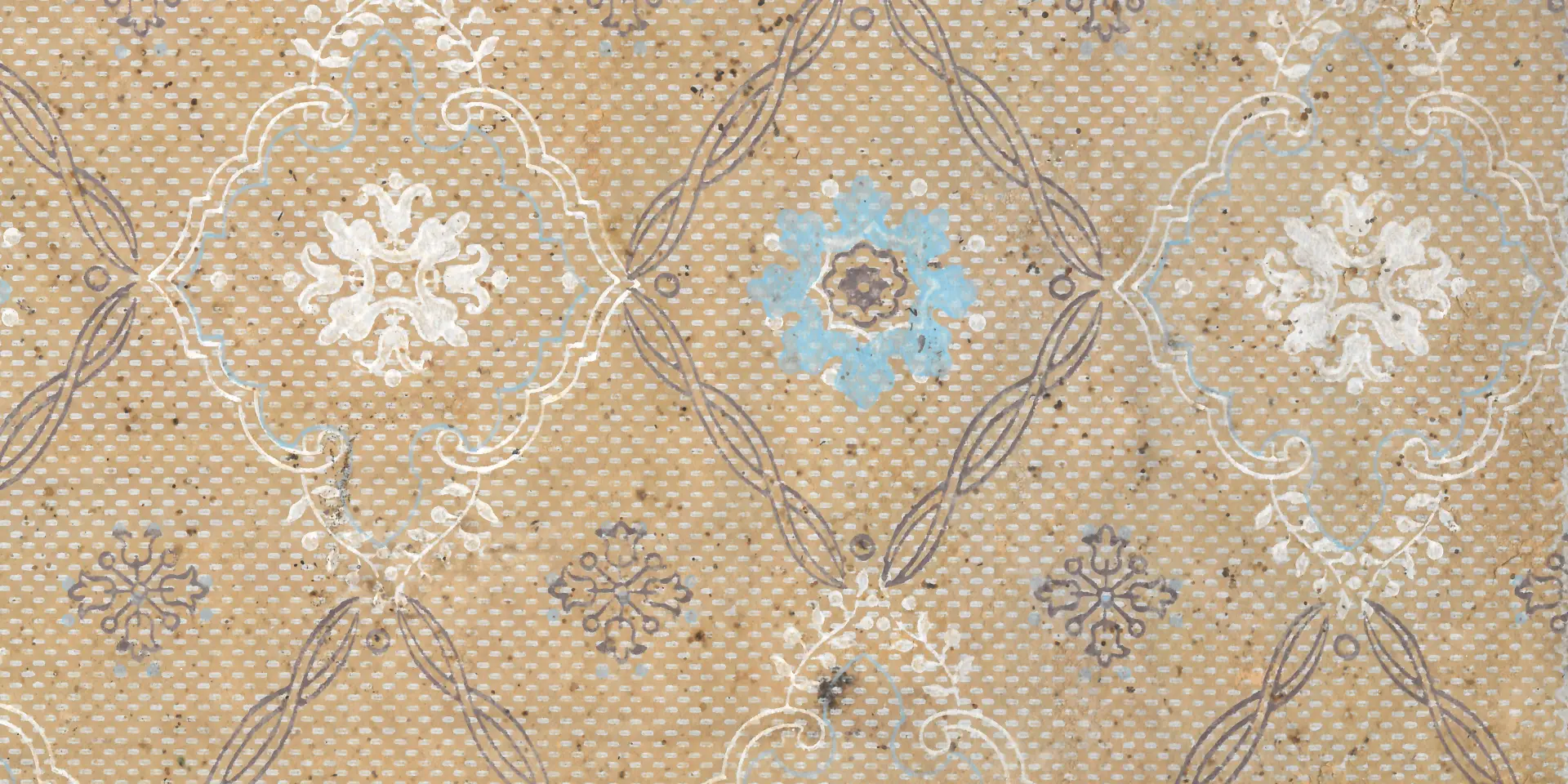
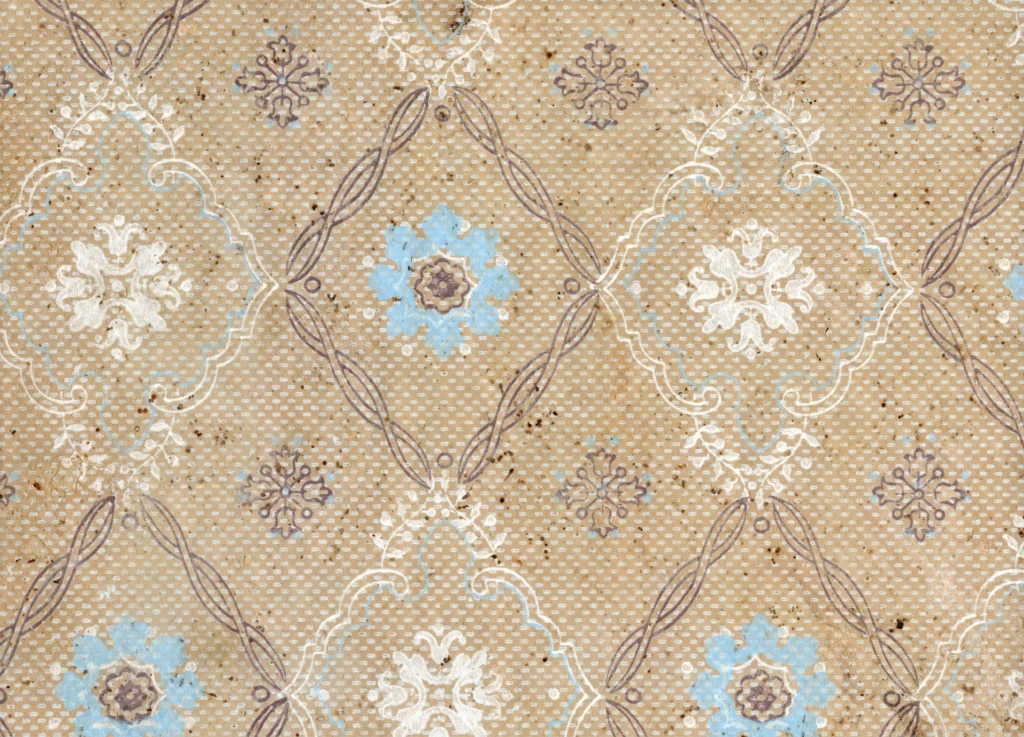
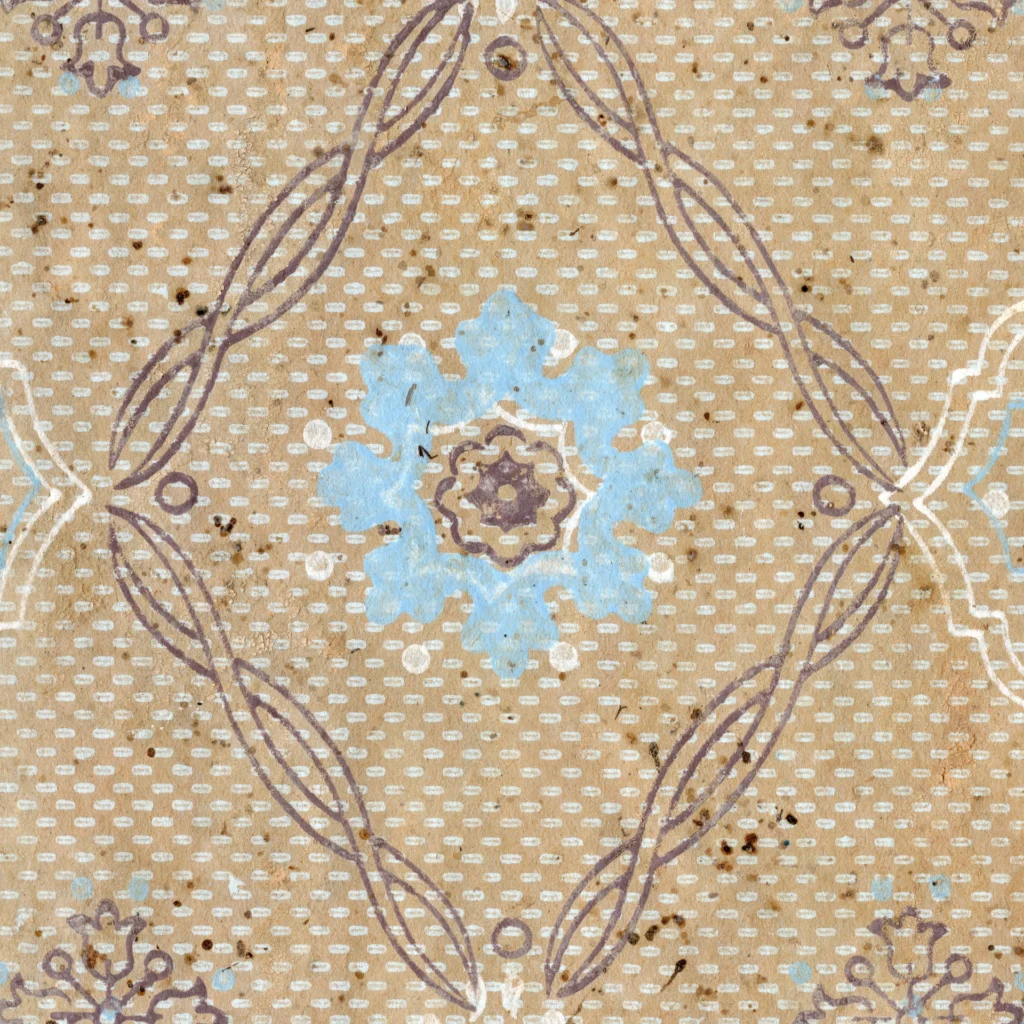
This wallpaper begins by printing tiny oval dots densely onto a pulp paper ground, imitating the texture of a fine woven fabric. Over this, a diamond grid composed of twisted vines and Rococo ornament is laid, and at each vertex of the grid hangs a vine knot stretched like a long laurel wreath. Taken as a whole, the diamond-shaped vines and decorations evoke either a climbing plant covering the lattice of a Western garden wall, or an intricate piece of lace.
(Source : Gosate Collection)
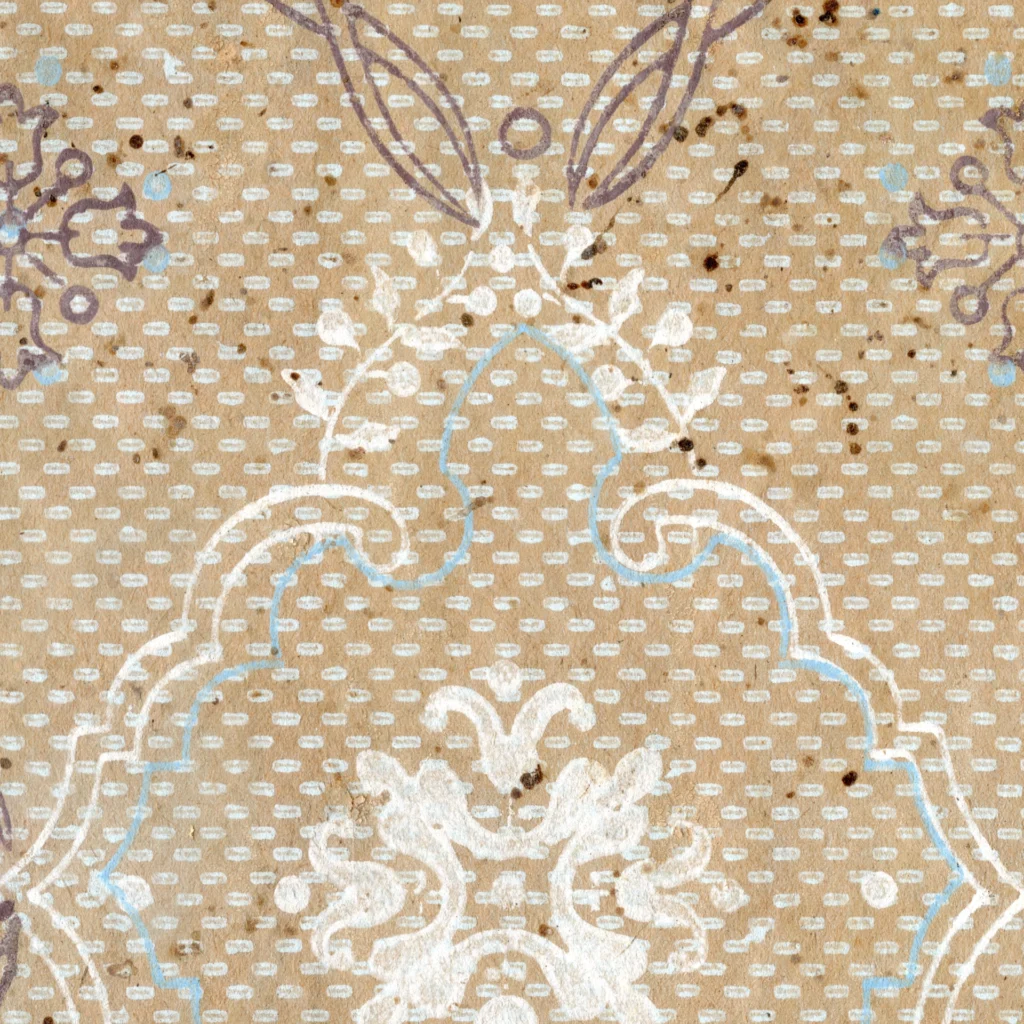
The motifs filling the interior of the grid are composed of two distinct units. The first is a diamond-shaped cartoucherendered in white ink. Its outline — swelling at the top and bottom, curling inward at the sides — evokes the frame of a Western picture or a family crest (emblem), and within it, leaves and curves extend in four directions. This ornament, which expresses a sense of volumetric mass through white ink on cheap paper in place of three-dimensional plaster relief, carries the air of a somewhat exaggerated lace decoration.
(Source : Gosate Collection)
(Source : Gosate Collection)
The second unit is a small floral motif — a dark center dot set against a pale sky-blue ground — that fills the spaces between the white cartouches, lending the composition a rhythmic color variation. Add to this the small snowflake-shaped star motifs scattered into every remaining gap, and the result is five overlapping layers running from the dot ground through the vines, cartouches, flowers, and snowflakes. This is less a restrained, refined damask pattern than a decorative sensibility closer to kitsch — one that piles on lace, ribbon, and flowers without reserve in pursuit of maximum extravagance.
2. The 'European Cartouche' Reinterpreted by Korean Interiors of the 1960s–70s
The grammatical roots of this pattern connect to 18th–19th century European Neoclassical and Rococo ornament. The structure of a central motif within a cartouche, surrounded by laurel wreaths and ribbons arranged diagonally — commonly found in wall panels, ceiling stucco, and textile designs of the period — has been translated into a flat printed wallpaper. In the European original, the cartouche would typically contain a royal or noble crest or symbolic iconography, with the surrounding decoration arranged in continuous medallion panels.

Public Domain via Wikimedia Commons [web:165]
When this aristocratic form encountered the Korean printing environment of the late 1960s and early 1970s, it was distinctively transformed. The delicate silk ground was replaced by dot-printed paper; the deeply shadowed central motif was simplified to a flat white mass with lines laid over it. The addition of pale sky-blue and violet accent colors completed an atmosphere less of classical gravitas than of a kitsch aesthetic — reflecting the yangok-pung (Western-style) taste of the era, its desire to decorate in a manner perceived as glamorously Western.
And yet the spatial structure is designed with considerable ambition. Rather than a simple repetition of floral units, the cartouches divide the surface like a net, with vines connecting the frames so that the whole reads as a single continuous decorative panel. This wallpaper is a vivid historical document of the vague longing Korean people of the time harbored for the Western salon. The very point at which the European original was transformed — through mass printing — into something rougher and lighter in sensibility is precisely what gives this pattern its historical character.
Copyright © 2026 Gosate Archive. All Rights Reserved.
All Rights Reserved.
- All text and scholarly analysis are the intellectual property of the author.
- All photographs marked "Gosate Collection" or "Photo by Gosate" are the copyright of GOSATE. Reproduction, copying, or distribution without prior consent is strictly prohibited.
- Historical images cited from external sources are subject to their respective copyright holders or public domain provisions.
Inquiries: contact@gosate.kr
More from this era