The Tile That Climbed the Wall: Stippled Octagonal Ceiling Paper
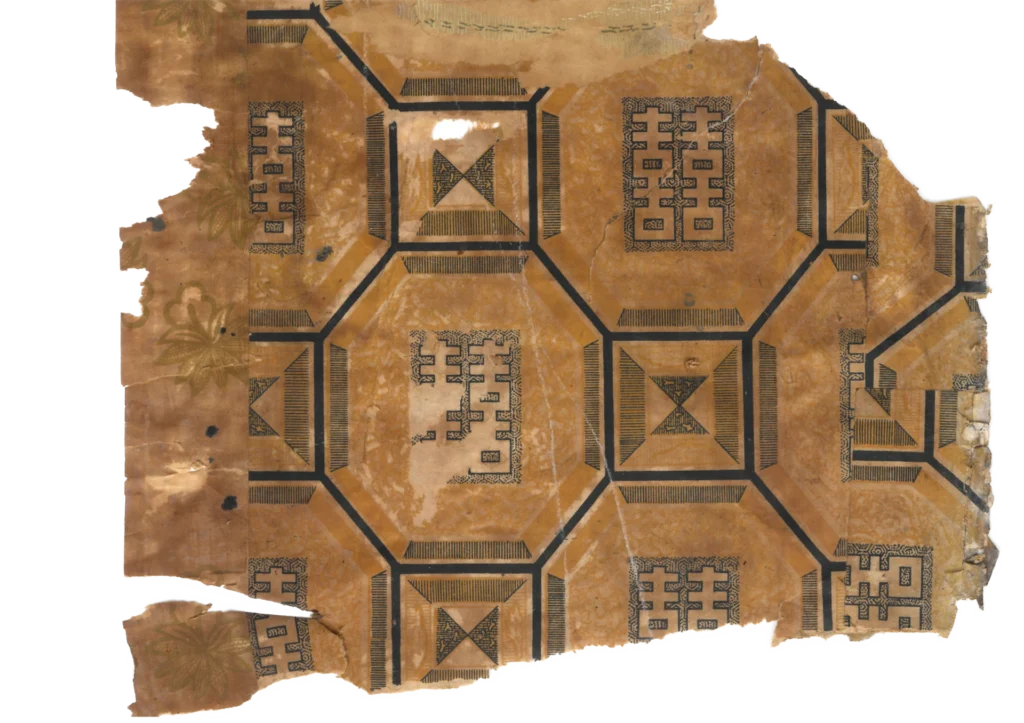
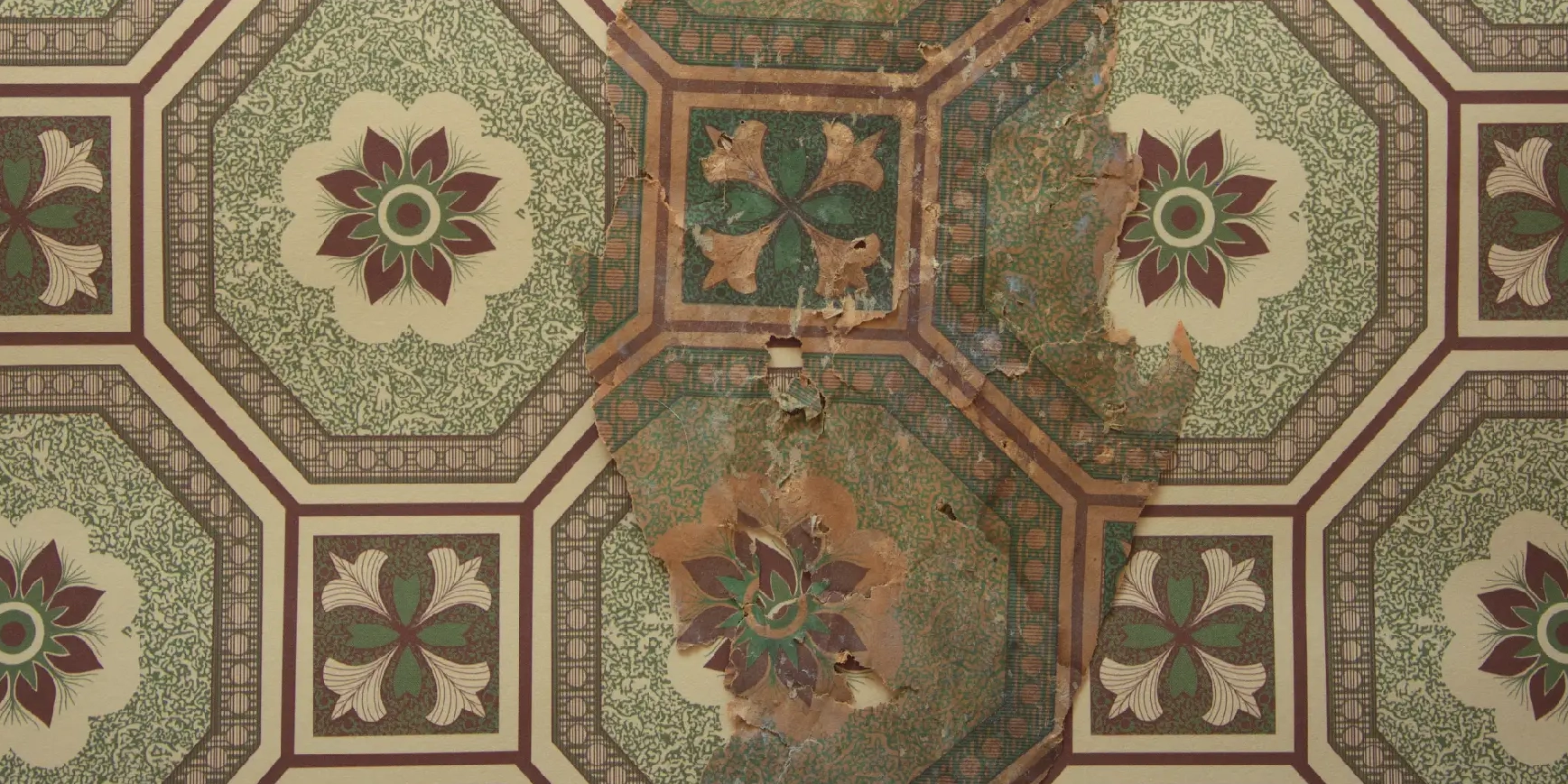
1. Anatomy of a Design: Soft Tiles Stacked on Paper Original and GOSATE reproduction of early 1960s ceiling wallpaper discovered in a 1945 historic home in Heunghwang-ri, Hwado-myeon, Ganghwa Island(Photo by Gosate 2025) At…
1. Anatomy of a Design: Soft Tiles Stacked on Paper

At first glance this ceiling paper appears to be a simple repeating pattern of flowers set within octagons — but its structure is built from carefully designed layers. At the base, a dense stipple texture covers the entire ground; over this, a grid of octagons and squares is laid; and finally, floral and leaf motifs anchor the center of each unit. Three layers in total. Within the large octagons sit eight-petaled rosettes; within the small squares, Neo-Gothic quatrefoil leaf forms.
What particularly draws the eye is the tonal treatment along the borders. Each grid unit is edged with a deep brown band, followed inward by a lighter beige border. This double-border structure introduces a subtle step and sense of depth onto the flat paper surface — the impression of stone or timber panels fitted together.
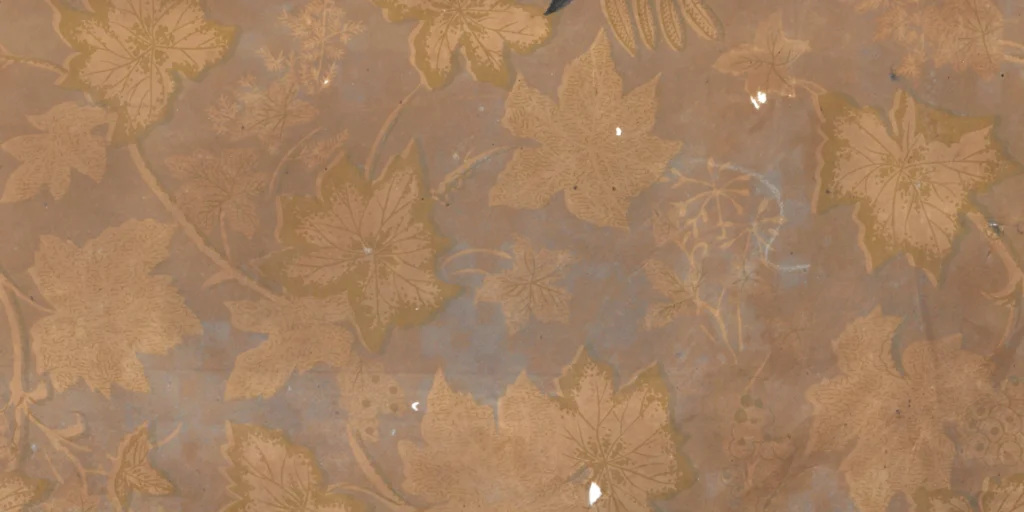
The dense green stippling filling the ground is equally purposeful. The stippling technique was widely used in popular print media of the 1950s–60s to render midtones — producing a far richer texture than a flat single-color field. Simultaneously, these fine dots evoke the woven surface of the premium fabrics — damask, tapestry — that wallpaper had aspired to imitate since the 19th century. Practically, a stippled background also naturally conceals minor printing errors, ink irregularities, and the small stains that accumulate over time.

stippling technique texture detail.
(Source: Collection of Gosate)

(Source: Collection of Gosate)

(Source: Collection of Gosate)
The geometric structure of this pattern follows the decorative grammar of encaustic and cement floor tiles fashionable in late 19th-century Europe — alternating octagons and squares in a chessboard arrangement, each unit filled with floral or geometric ornament. This tile vocabulary presented the floor as solid and dignified, and was soon carried over into wallpaper design as well.
2. A Tradition of Ceiling Decoration: The Grid That East and West Share
What makes this pattern truly interesting, however, is not only its debt to floor tile. The interlocking geometry of octagons and squares was, in fact, a long-established method of decorating ceilings in both Eastern and Western traditions.
The Western Coffered Ceiling. From the Renaissance onward, European palaces and manor houses used the coffered ceiling — a grid of square or octagonal panels, each centered with a rosette or decorative motif — as the hallmark of refinement. Originally a costly construction in stone or timber molding, from the mid-19th century plaster molding and wallpaper began to carry its effect into the middle-class home.
The East Asian Gyeok Ceiling. In the traditional timber architecture of Korea, Japan, and China, an equivalent structure — the lattice ceiling (gyeokcheonjang, 格天井) — was widely used in temples, palaces, and the daecheong halls of aristocratic houses. Timber was fitted into a grid and each panel decorated with dancheong pigment or floral ornament, simultaneously elevating the dignity of the space and providing structural stability.
Victorian Ceiling Wallpaper. In late 19th-century Britain, papering the ceilings of middle-class homes was highly fashionable. Tile patterns and geometric designs applied across the whole ceiling to simulate a molding structure were regarded as a marker of the modern, hygienic interior. Under the influence of Anglo-Japonism, Eastern geometric patterns also gained popularity, with a large central rosette flanked by surrounding grid patterns becoming the standard composition.
The octagonal grid of this wallpaper thus connects not only to European floor tile but to a shared grammar of ceiling decoration running through both Eastern and Western architectural traditions. From the late 19th into the early 20th century, the tile pattern migrated from floor to wall to ceiling, establishing itself as a popular decorative mode: the luxury molding structure, reproduced in cheap wallpaper.

(Source: Collection of Gosate)
3. A Korean Reception: A 'Paper Lattice Ceiling' Printed by Copper-Plate Offset
This early 1960s Korean ceiling paper is the result of translating this international current into Korean technology and domestic conditions.
Why geometric patterns suit the ceiling. First, the octagon-and-square repeat has no directionality — unlike vine or floral patterns, which must align top-to-bottom and left-to-right, a geometric grid can be applied in any orientation without error. Second, the ceiling is not a surface where the eye lingers — stable, repetitive symmetry is psychologically restful in a way that complex narrative patterns are not. Third, the grid structure evokes the traditional lattice ceiling and the coffered ceiling, conveying the impression of a dignified, finely finished ceiling without expensive timber or plaster molding.
The precision of copper-plate offset printing. A second important fact this wallpaper demonstrates is the considerable level of wallpaper production technology in early 1960s Korea. The complex octagon and square lines interlock without distortion; the fine background stippling is uniformly distributed across the whole surface. This points to the application of copper-plate offset printing — a step beyond woodblock or simple rubber rollers, capable of delivering precise lines and dots with consistent uniformity. Copper-plate offset was less expensive than gravure while offering the precision required for fine line and stipple work, and established itself as a primary production method for the Korean wallpaper industry from the late 1950s.
In the end, this ceiling paper may be understood as a paper lattice ceiling: built on the decorative tile grammar of 19th-century Europe, resonating with the geometric ceiling traditions of both East and West, and realized through the precision printing technology of 1960s Korea. Without costly timber molding or plaster ornament, it brought a dignified ceiling to the homes of ordinary people — and that is precisely what makes it worth preserving.
Copyright © 2026 Gosate Archive. All Rights Reserved.
All Rights Reserved.
- All text and scholarly analysis are the intellectual property of the author.
- All photographs marked "Gosate Collection" or "Photo by Gosate" are the copyright of GOSATE. Reproduction, copying, or distribution without prior consent is strictly prohibited.
- Historical images cited from external sources are subject to their respective copyright holders or public domain provisions.
Inquiries: contact@gosate.kr
More from this era