
Damask on a Lattice — A 1940s Wallpaper Where East Meets West
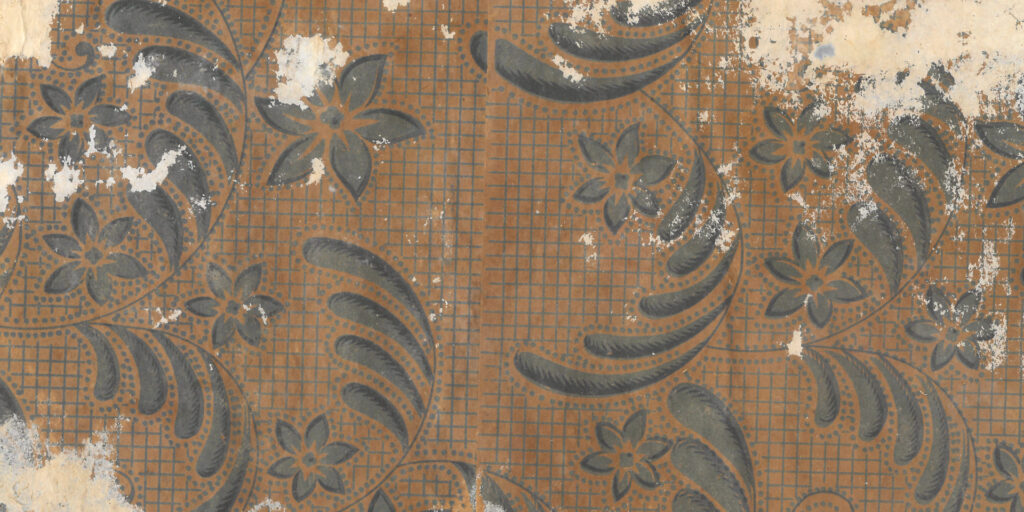
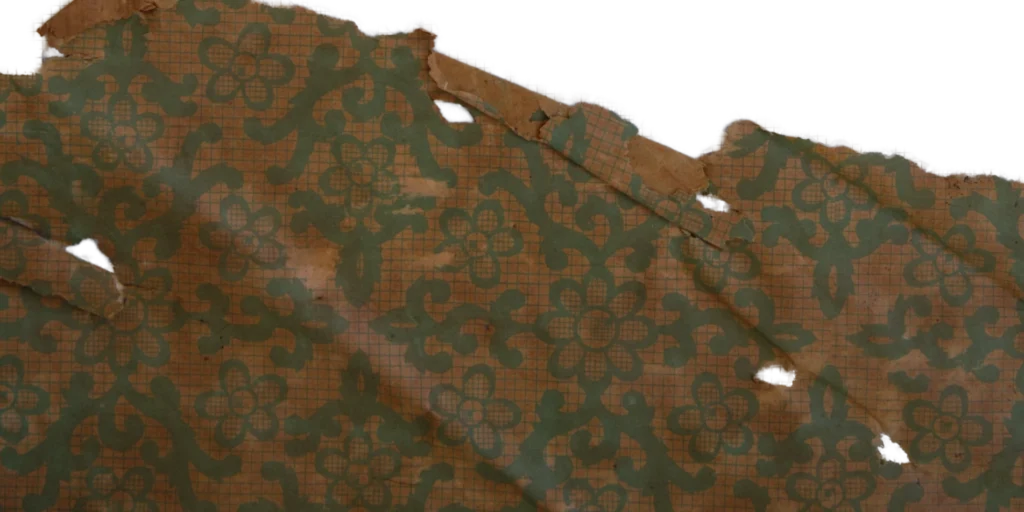
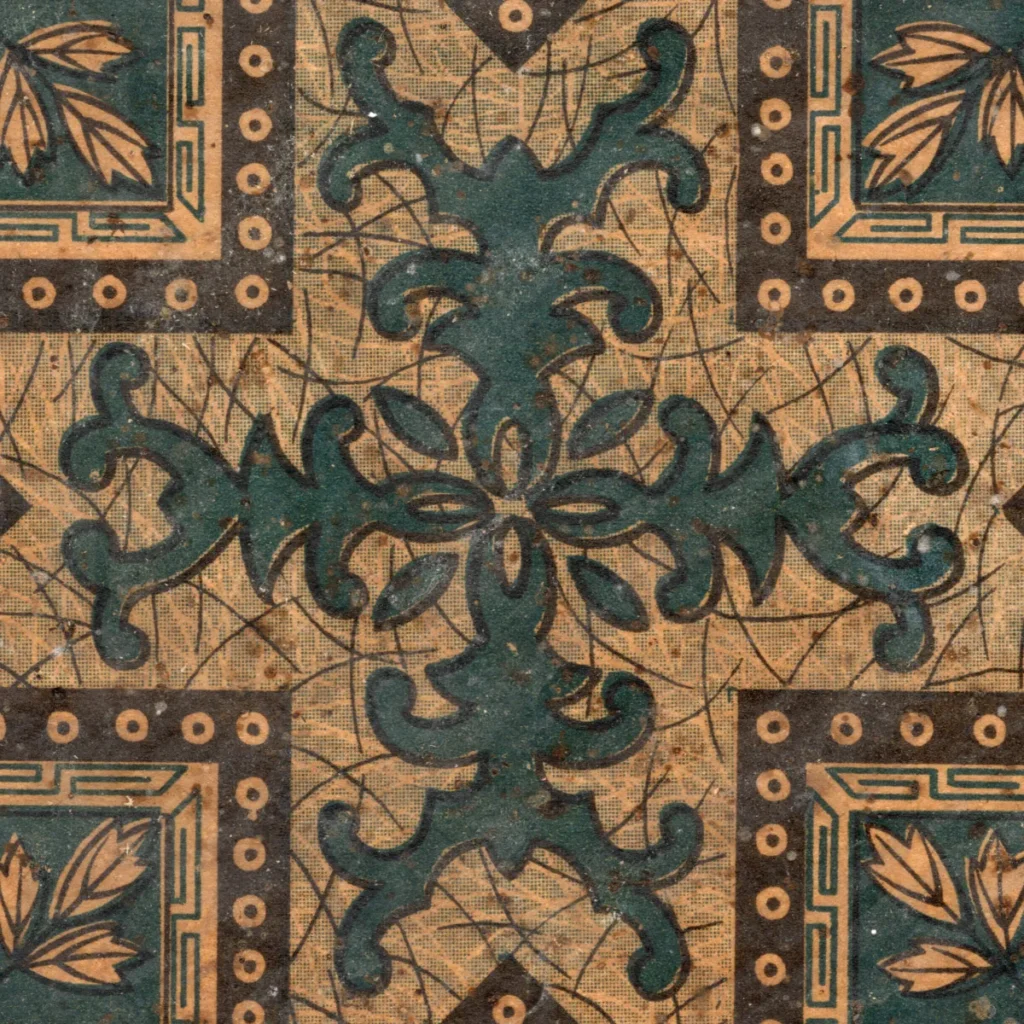
Wallpaper "Weolja" — original scan (Source: Collection of Gosate) Visual Observations Recovered from a 1940s hanok, this wallpaper — which we'll call "Weolja" — is a single-color print, pressed onto pulp paper with nothing…

Visual Observations
Recovered from a 1940s hanok, this wallpaper — which we’ll call “Weolja” — is a single-color print, pressed onto pulp paper with nothing but green ink. Some seventy-odd years have oxidized the paper to a yellowish brown and drained a good deal of the green’s original saturation, but the bones of the pattern still read clearly on the surface.
The first thing to notice is that although only one ink was used, the surface reads in two distinct tones. This isn’t a second color at work but the result of contrasting the solidly inked silhouette of the main motif against the finer dot density of the lattice beneath it. Depth and shading are conjured not by adding colors but by varying the density of the line itself.
The Woven Ground
A fine lattice runs across the entire surface. This grid, drifting beneath the primary motif, is not an accident of printing but a clearly intended ground. Its role is to send a visual signal: this is not paper, it is cloth.
That signal takes on added weight once you remember that the surface motif is a damask. The word “damask” itself comes from a style of silk weaving, and the whole reason damask wallpaper exists in the first place was to make a wall look “as if it were draped in silk.” Here, then, the lattice isn’t just a filler texture — it is the alibi that disguises paper as fabric. The paper mimics silk, and the lattice underneath vouches for that silkiness one more time: a doubled sleight of hand.
The Damask Skeleton
The pattern follows a classic all-over damask structure laid out over an ogee-and-diamond framework. A radial daisy- or aster-like rosette sits neatly at every crossing of the lattice, joined by symmetrical scrolling motifs, with smaller flowers tucked into the gaps as filler. This hierarchy — central rosette, connecting scroll, filler bloom — is the direct grammar of Western damask wallpaper, inherited more or less wholesale from French and English forebears.
Judging from this alone, “Weolja” might look like a faithful imitation of a European style. But the decisive clue is hiding in how the motifs end.
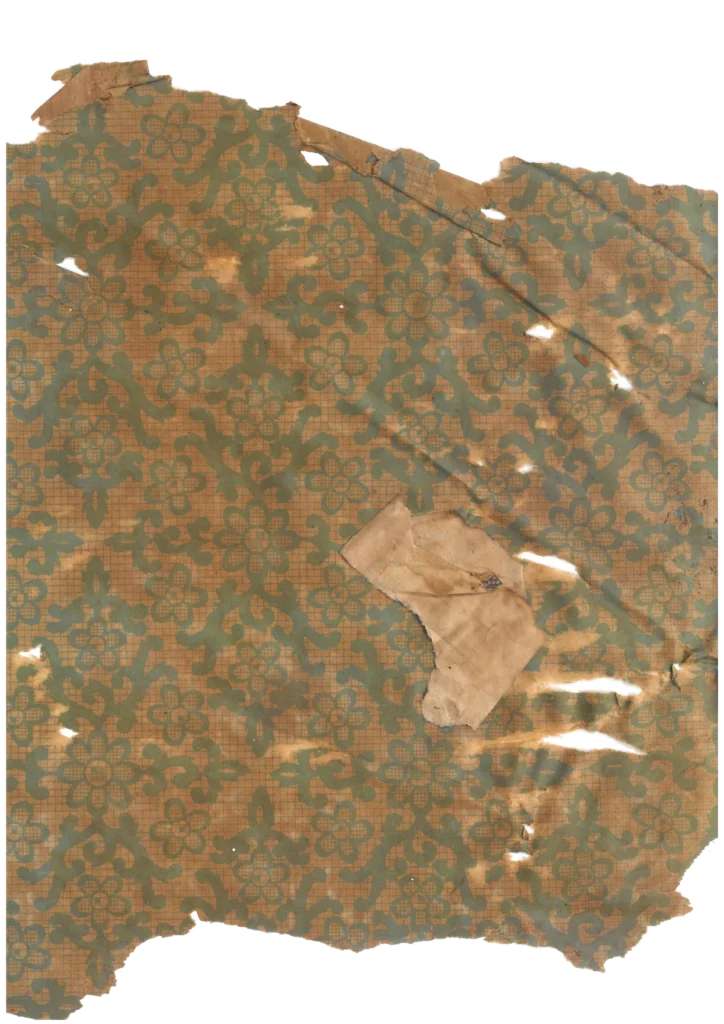
Structural analysis of the “Weolja” pattern. A textbook damask layout: central rosettes and symmetrical scrolls arranged over an ogee-and-diamond framework. (Source: Collection of Gosate)
Rounded Endings — An Eastern Hand on a Western Motif
The defining feature of the European acanthus is its jagged, serrated edges and the sharp lobed splits along the leaf. The Greek version is pointed and knife-like; the Roman variant softens somewhat, but the lobing and the rhythmic curl of the leaf are preserved to the very end.
Not so with “Weolja.” Its scrolls have almost no serration; they resolve instead into smooth, rounded hooks or club-like tips. That rounded closure is not the vocabulary of Western acanthus. It is the mother tongue of East Asian scrolling-vine motifs — the dangcho (卷草), the yeoui (如意), the unmun (雲紋). Just as the head of a yeoui closes into the rounded form of a fist, a cloud, or a yeongji mushroom, the scrolls here settle into smooth, club-shaped ends. A Western skeleton, then, with the tip of an Eastern brush laid over it.
We looked closely at this same phenomenon — the sharp Western acanthus softened and rounded off by an East Asian hand — in an earlier piece on the “Jaeho” wallpaper recovered from Gyodong Island. The sensibility of “Shanghai Modern,” visible in the yuefenpai (月份牌) advertising prints of 1930s and ’40s Shanghai — that particular knack for taking a Western style and dissolving it into the softer strokes of East Asian painting — runs through the resolution of “Weolja” in exactly the same way.
Related reading: 1943 Gyodong (喬桐): The Ink of Empire, and the Reality Behind the Wallpaper
One caveat is worth noting. Europe has its own “rounded acanthus” — the Roman variant — so a rounded tip alone is not enough to declare a motif East Asian. The real test is not rounded or not but whether the serration and lobing survive. In “Weolja,” those lobed edges have been almost entirely smoothed away.

In sum, “Weolja” holds two layers at once. Its structure is Western damask; the finishing of its details is East Asian scrolling-vine. It is a hybrid — the vessel of a Western silk pattern, filled with the rounded curves left by an Eastern brush.
Copyright © 2026 Gosate Archive.
All Rights Reserved.
- All text and scholarly analysis are the intellectual property of the author.
- All photographs marked “Gosate Collection” or “Photo by Gosate” are the copyright of GOSATE. Reproduction, copying, or distribution without prior consent is strictly prohibited.
- Historical images cited from external sources are subject to their respective copyright holders or public domain provisions.
Inquiries: contact@gosate.kr
More from this era