
A Gothic Garden — Medieval Visions in Japanese Colonial Wallpaper on the Korean Peninsula
Ogee arches, palmettes, dense ground textures, and two-color printing place this colonial-period wallpaper within the afterlife of European Gothic Revival ornament in East Asia.


(Source: Collection of Gosate)
Visual Observation
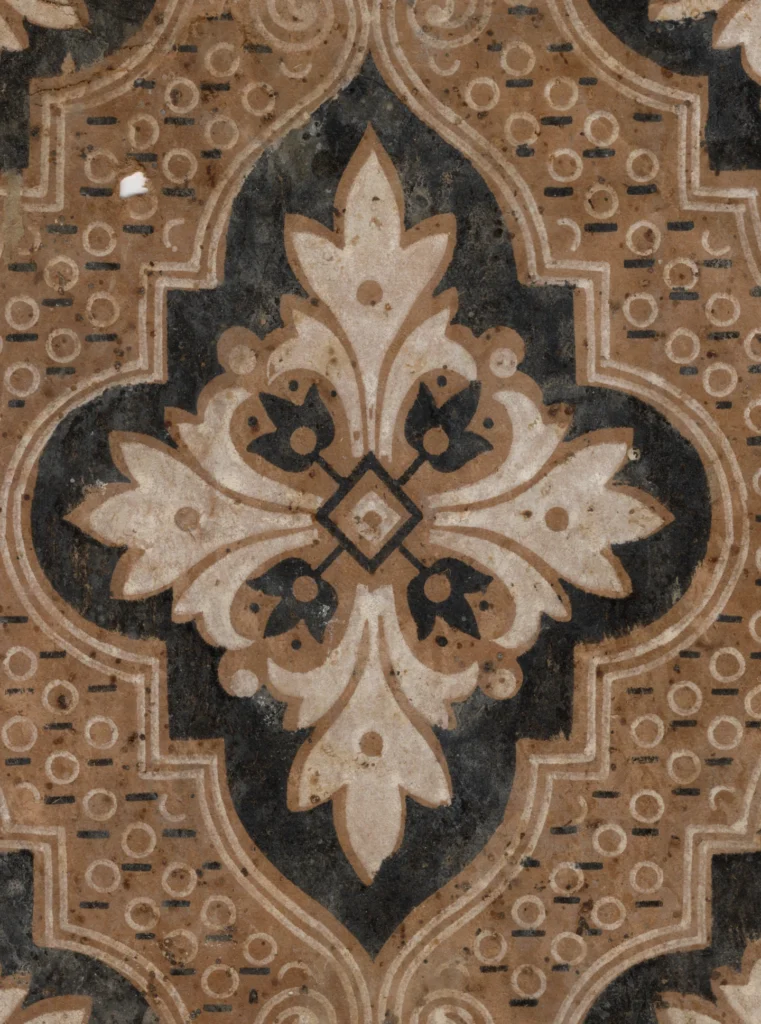
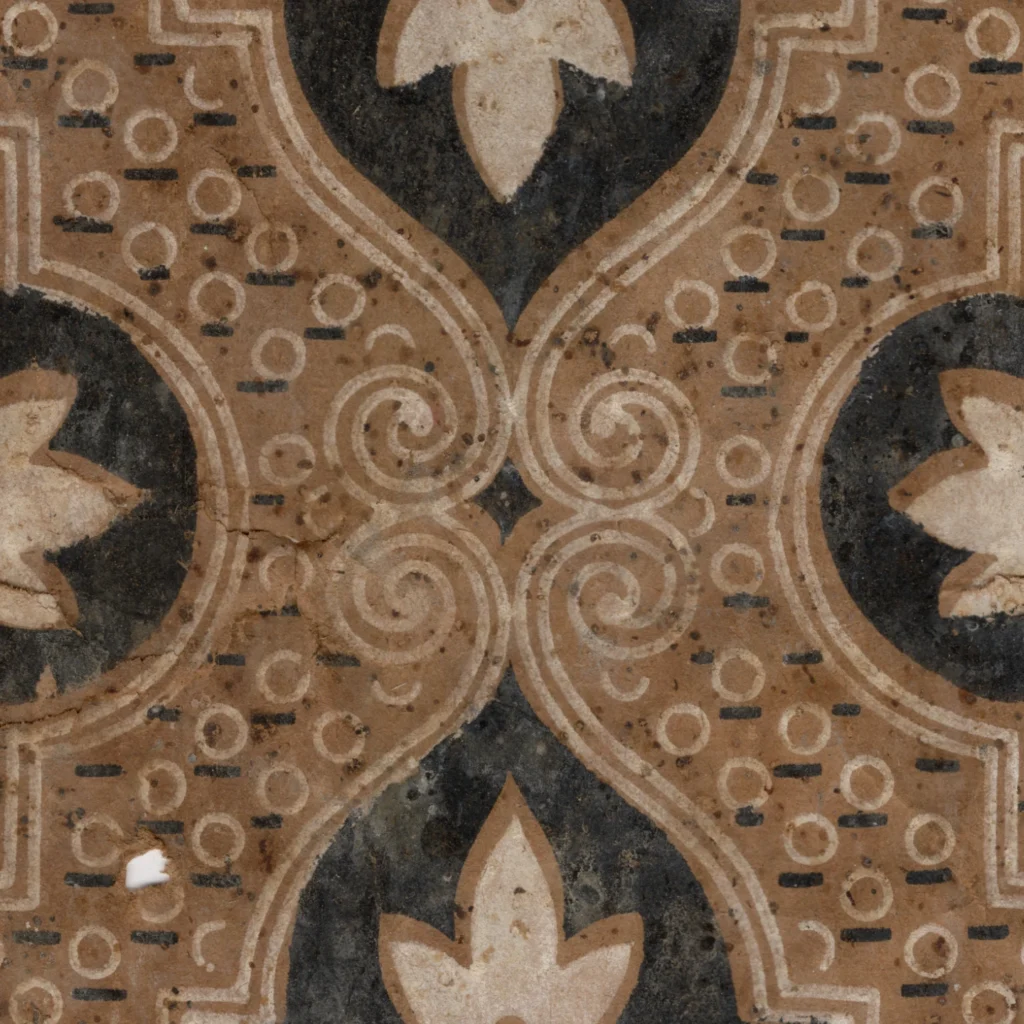
This wallpaper is printed on yellow-brown kraft paper with two inks, white and black. Including the paper color, the surface contains three visual layers: the warm ground, the white main motifs, and the black shadows and details.
The field is organized by a refined lattice of rounded pointed arches, or ogee arches. These cells repeat across the surface, and each contains a stylized plant motif. The pattern feels architectural, almost like a wall of small Gothic windows.
Inside each medallion sits a palmette or anthemion-like plant. Leaves unfold symmetrically, with small jewel-like details at the center. The spaces between the medallions are not left empty; they are filled with tiny circles and horizontal strokes, adding density to the whole field.
(Source: Collection of Gosate)
Gothic Revival Vocabulary
The visual language belongs unmistakably to the European Gothic Revival. Nineteenth-century designers such as A. W. N. Pugin translated medieval Gothic architecture and ornament into modern interiors, emphasizing pointed arches, stylized foliage, and moralized pattern.
This wallpaper carries several of those signs: the ogee arch, symmetrical foliate medallions, dense all-over ornament, and a strong sense of structural repetition. It is not a literal medieval design, but a modern printed echo of Gothic Revival decoration.
How Gothic Reached a Korean Wall
By the early twentieth century, Gothic Revival ornament had already traveled through British design books, European wallpaper manufacture, Japanese design education, and export catalogues. Under Japanese colonial rule, such patterns could enter the Korean Peninsula through imported or Japan-made wallcoverings.
(Source: Collection of Gosate)
Placed in a Korean domestic setting, the paper becomes a layered object. Its material is modest kraft paper; its printing is economical; its design ancestry reaches back to European medievalism as reinterpreted by nineteenth-century revivalists and then recirculated through Japan.
The result is a Gothic garden on paper: a medieval fantasy translated, industrialized, and finally installed far from the churches and halls that first inspired it.
The Route of a Medieval Fantasy
The wallpaper is striking because its style is so far removed from the Korean house in which it was found. The pointed arches, dark tones, and medallion structure belong to the long afterlife of European Gothic Revival ornament. Yet by 1940, that vocabulary had traveled far enough to appear on a wall in the Korean Peninsula.

The route was indirect. Gothic Revival design moved from nineteenth-century Britain into pattern books, wallpaper catalogues, export goods, and Japanese design education. From there, under the conditions of empire and colonial trade, it could reach Korean interiors as a ready-made sign of Western formality.
Victorian Weight
The most powerful quality of this wallpaper is its seriousness. It is not a light floral paper. It does not aim for freshness or intimacy. The black ink, dense ground, and repeated arch structure create a formal and weighty atmosphere.
This corresponds closely to late Victorian interior taste, where walls were often dark, densely patterned, and filled with moral or historical associations. Empty surfaces were avoided. Decoration gave a room gravity.
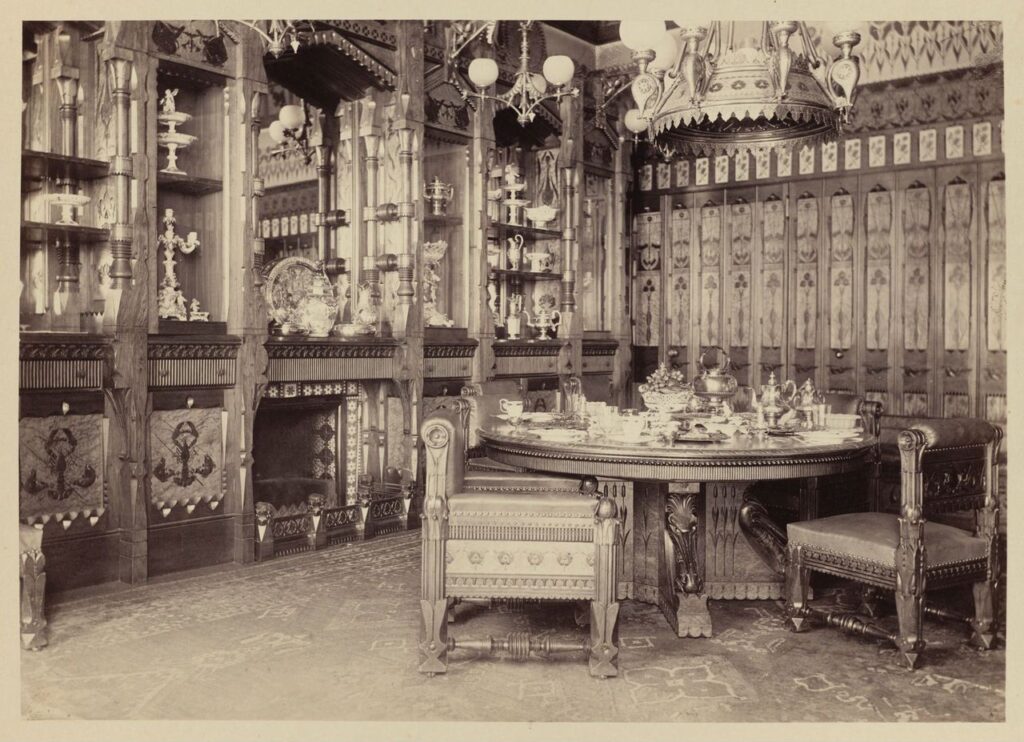
In a colonial Korean house, such gravity could signal modernity, education, and cosmopolitan taste. The paper functioned not only as ornament but as a social surface, suitable for a reception room or formal sitting room.
Printing a Gothic Interior
The printing itself is economical: white and black ink over kraft paper. Yet the three-tone system is effective. Black creates depth, white defines the motifs, and the paper color becomes the middle tone. This limited palette allows the design to feel richer than its material means.
The result is a compressed Gothic interior. It does not require carved wood, stained glass, or stone tracery. It prints the idea of Gothic seriousness onto paper.
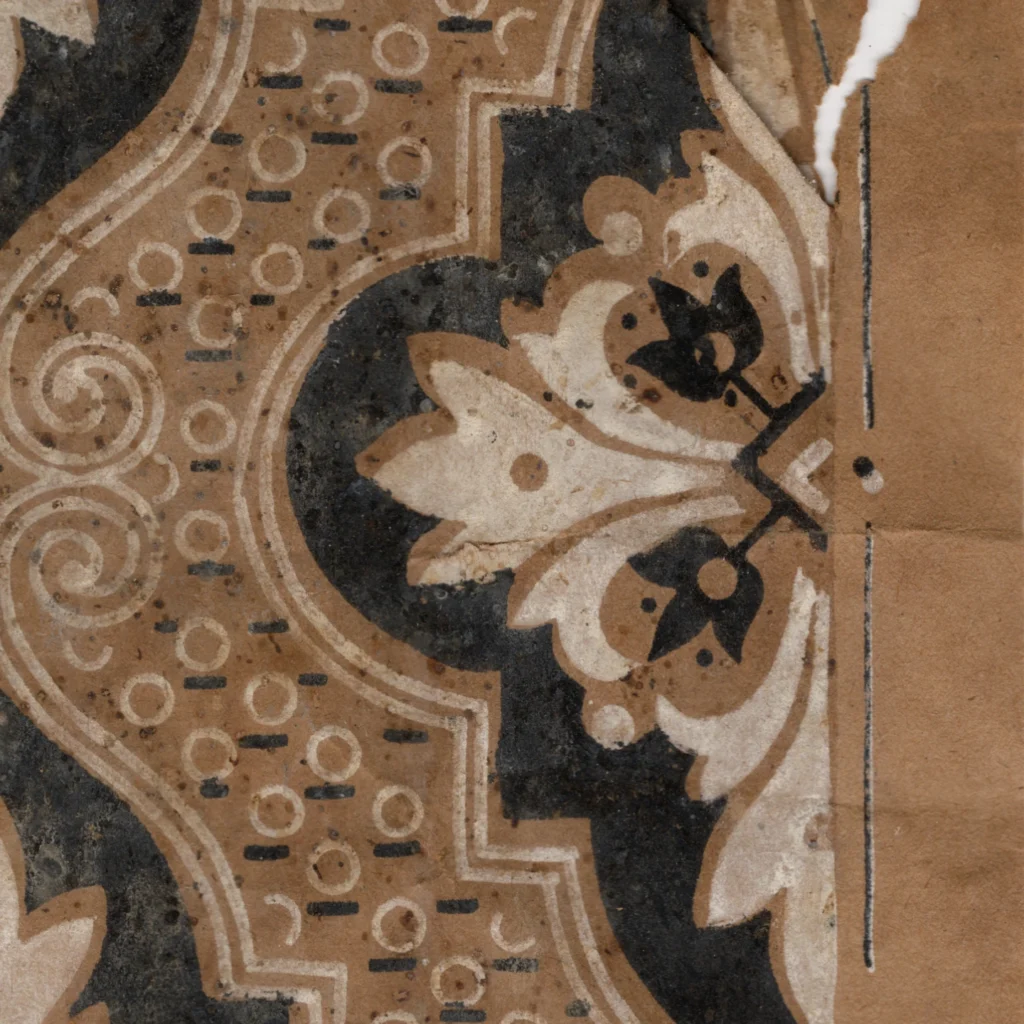
(Source: Collection of Gosate)
Why It Matters
This wallpaper is a small but vivid example of how design vocabularies move. A medieval fantasy revived in nineteenth-century Britain, industrialized through wallpaper production, absorbed into Japanese manufacture, and installed in colonial Korea: all of that history is folded into one surface.
What remains today is only a fragment of paper, but the pattern still carries its weight. It shows that even the most ordinary wall covering can be a document of global design history.
Copyright © 2026 GOSATÉ Archive. All Rights Reserved.
Wallpaper from this research
Bongcheol
1940s
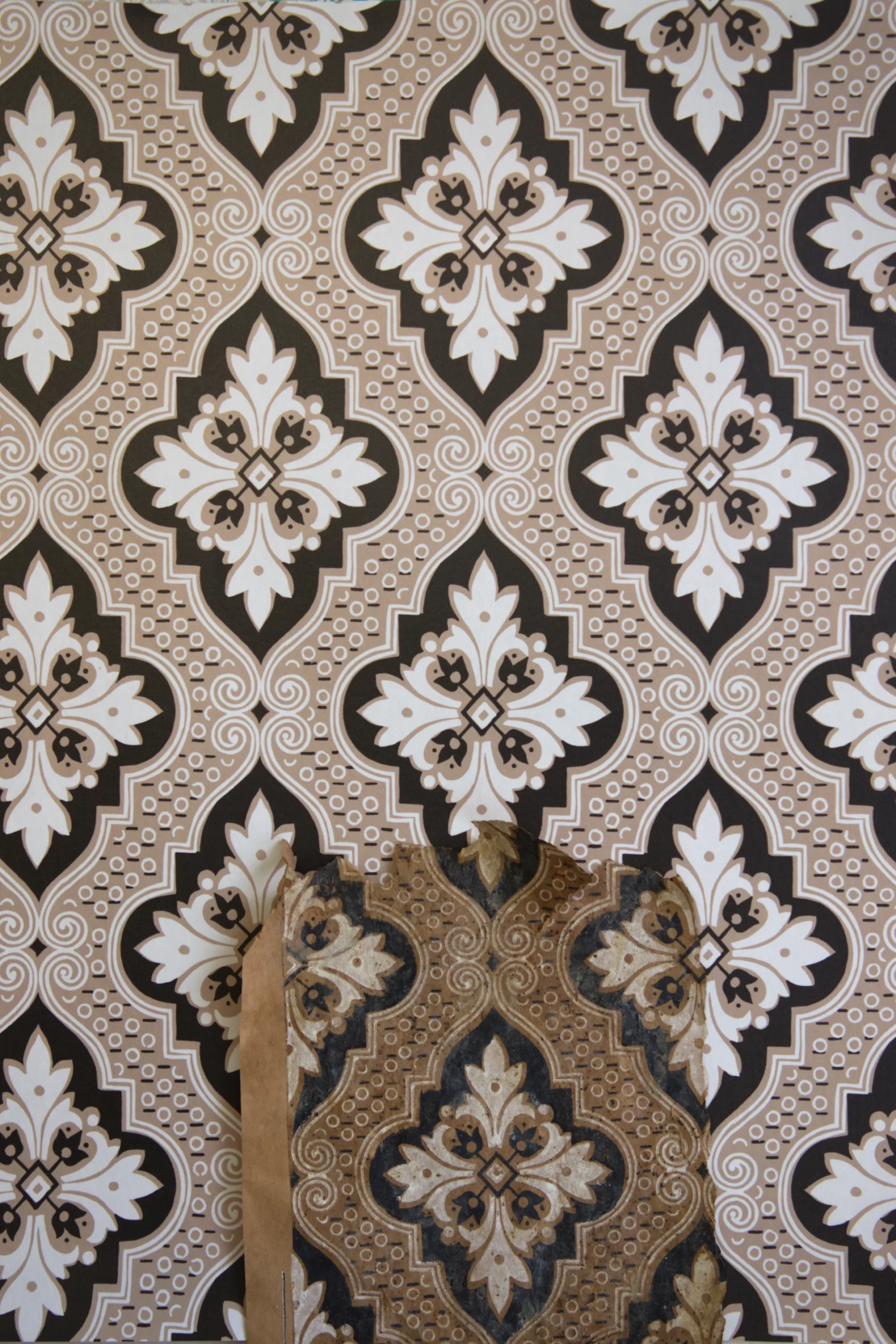
GOSATÉ restores forgotten patterns as wallpapers for contemporary spaces through the collection, documentation, and study of historic originals. A portion of every reproduction sale supports the continuing discovery, preservation, and research of Korean wallpaper.
- Colorways
- Original
- Material
- Non-woven / Peel & Stick
- Sizes
- 50x6m / 50x10m / 50x244cm
- Delivery
- Approx. 3-5 days – Free shipping
More from this era