
From Eurasia to Joseon: The Byzantine Legacy Transformed
1. The Byzantine Octagram and Its Two Paths The interlocking cross pattern at the heart of this design originates in the mosaic and decorative arts of the Byzantine Empire. The Byzantine decorative grammar —…
1. The Byzantine Octagram and Its Two Paths
The interlocking cross pattern at the heart of this design originates in the mosaic and decorative arts of the Byzantine Empire. The Byzantine decorative grammar — defined by its pursuit of geometric precision — spread in two broad directions as the empire declined and its influence dispersed.
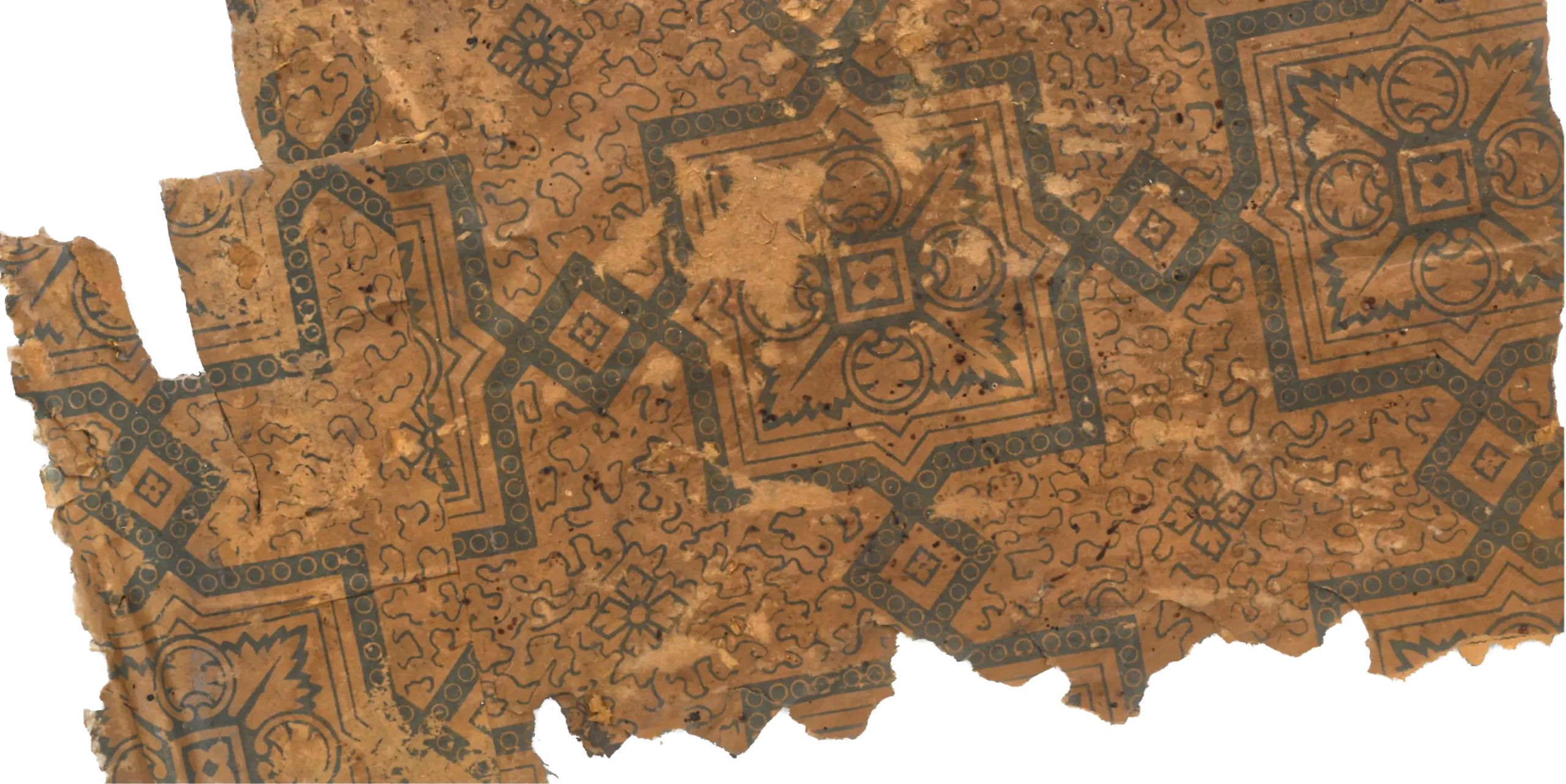
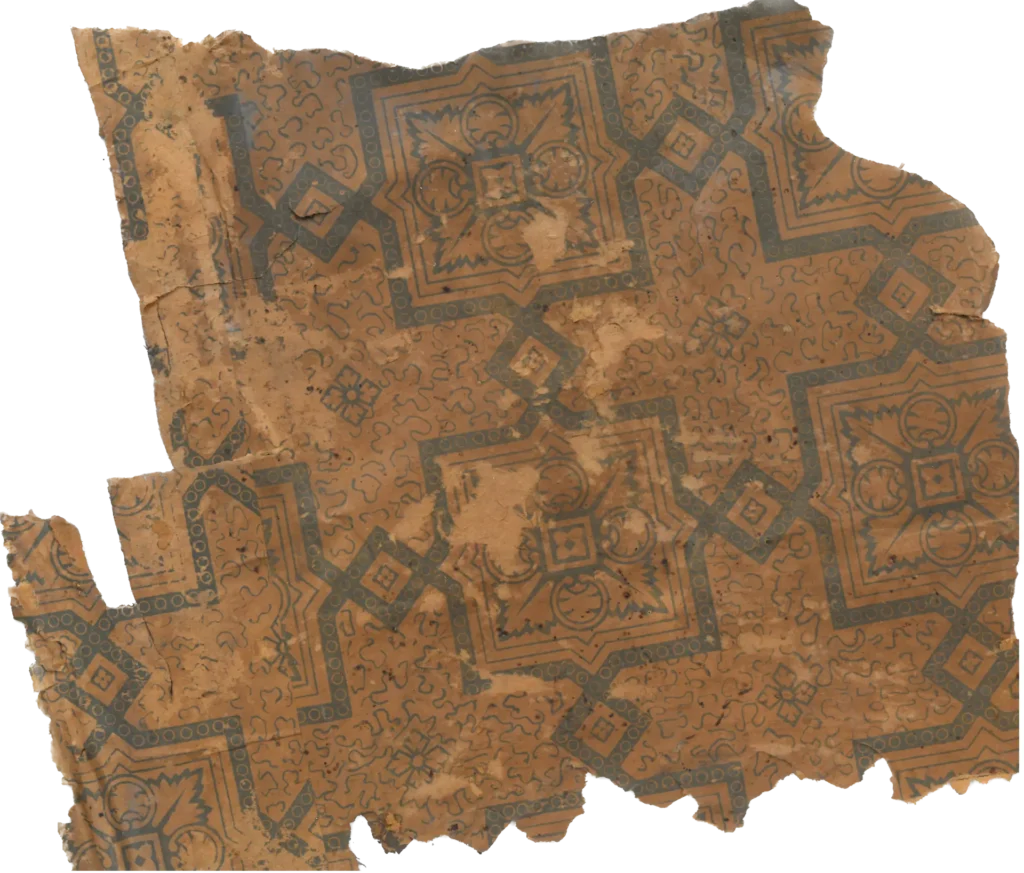
The first was a Western European route, passing through Italy and France before reaching Britain. The Byzantine grid vocabulary merged with the 19th-century Gothic Revival, finding new expression in the encaustic tiles that adorned the floors of medieval-style cathedrals. In industrial-era Britain, this geometric framework was further developed by incorporating the beading ornament of Majolica tiles — forming the prototype of the “tile-style” frame visible in this wallpaper.
The second was a northern route, transmitted to Russia through the Eastern Orthodox Church. The octagram, which took root in Russian icons, folk embroidery, and architectural ornament, was carried into Northeast Asian design markets by White Russian émigrés who settled in Harbin and Manchuria.
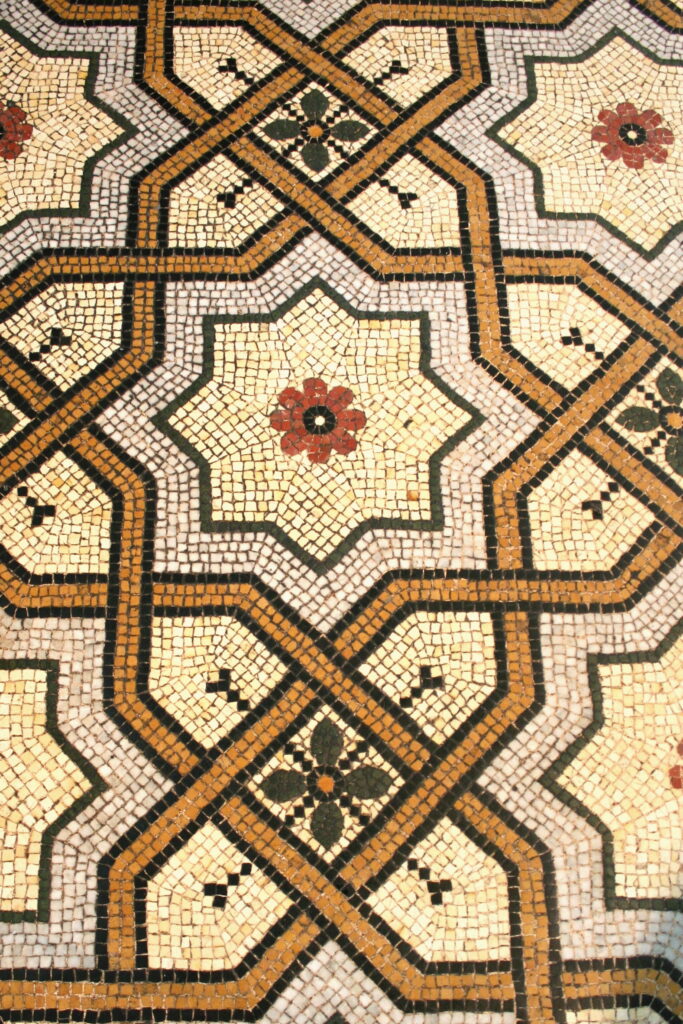
This 19th-century Byzantine Revival mosaic exemplifies the interlocking structure in which overlapping crosses form alternating octagons and diamond grids.
Source : Wikimedia Commons
(Photo by MOSSOT)
license : CC BY-SA 4.0
2. The Meeting of Civilizations: Convergence via Shanghai and Manchuria
These two lineages, propagated in opposite directions across Eurasia, reconverged in the early 20th century in Shanghai and Manchuria — the design hubs of Asia at the time. Two compelling hypotheses can be considered regarding the path by which this wallpaper reached the Korean peninsula.
The Shanghai Influence?: A Southern Route of Eclectic Transformation
The first possibility is that the design arrived through Shanghai, the epicenter of Asian design in the 1930s. Shanghai was actively absorbing Western Art Deco on its own terms, developing a distinctive eclectic style known as Haipai (海派).
Shanghai design characteristically inserted Eastern motifs and pictorial sensibilities into Western geometric frameworks. The placement of a bosanghua-like or Tudor Rose-style medallion within the encaustic tile grid of this wallpaper is consistent with this Haipai eclecticism.
It is plausible that printed sheets or finished goods produced in Shanghai entered Korea directly through the ports of Busan or Incheon — or alternatively, that Japanese wallpaper manufacturers, attuned to Shanghai’s fashions, commercially adapted these designs for the Korean market.

A fine example of the “eclectic” design aesthetic prevalent in China at the time. Designs evoking Western acanthus motifs through the form of the ruyi head ornament were in vogue. Covers of The Eastern Miscellany designed by Chen Zhifo, 1927–1928. Photos from Guan Shanyue Art Museum.
Covers of The Eastern Miscellany magazines designed by Chen Zhifo in 1927-1928. Photos from Guan Shanyue Art Museum
The Manchurian and Russian Influence?: A Continental Aesthetic via the Northern Route
The second hypothesis focuses on a northern route descending through Harbin and Manchukuo to the Korean peninsula.
The octagram structure — formed by eight directional axes created by overlapping crosses — is a geometric heritage found abundantly in Russian Orthodox iconography and Slavic folk embroidery. It is possible that the aesthetic of White Russian émigrés in Harbin, combined with the imposing classicism of Manchukuo’s architectural culture, influenced the design templates of Japanese manufacturers — or that the wallpaper itself may have been produced in Manchuria.
3. The Absorption of Northeast Asian Motifs
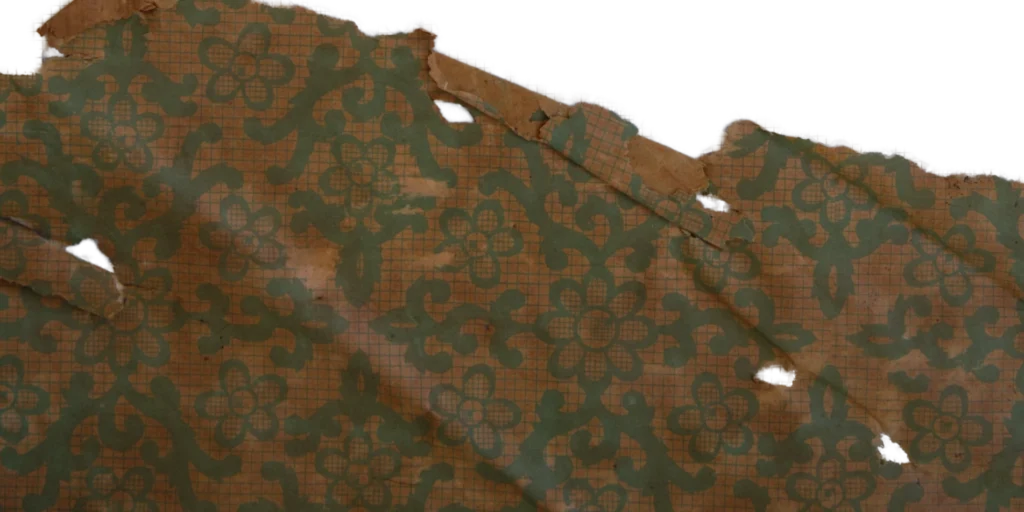
The Western framework that traveled across Eurasia was ultimately fused with the native visual vocabulary of Northeast Asia, including the Korean peninsula. The four-petaled floral motif at the center of the medallion closely resembles the juhwamun (persimmon calyx pattern) found in traditional Korean dancheong (painted architectural decoration), while the soekkomun (ring-nose motif, a variant of the ruyi head) placed at the corners of the pattern is also a noteworthy detail
Both the juhwamun and the soekkomun — derived from the shape of a cattle nose-ring — were traditional auspicious symbols commonly used in China and Joseon. Their presence here illustrates how Western geometric frameworks were localized. This composition, in which a Western botanical or cross medallion is transformed into a bosanghua form and paired with soekkomun, is a compelling example of how Western decorative culture was selectively adapted and domesticated across Northeast Asia in the modern era.

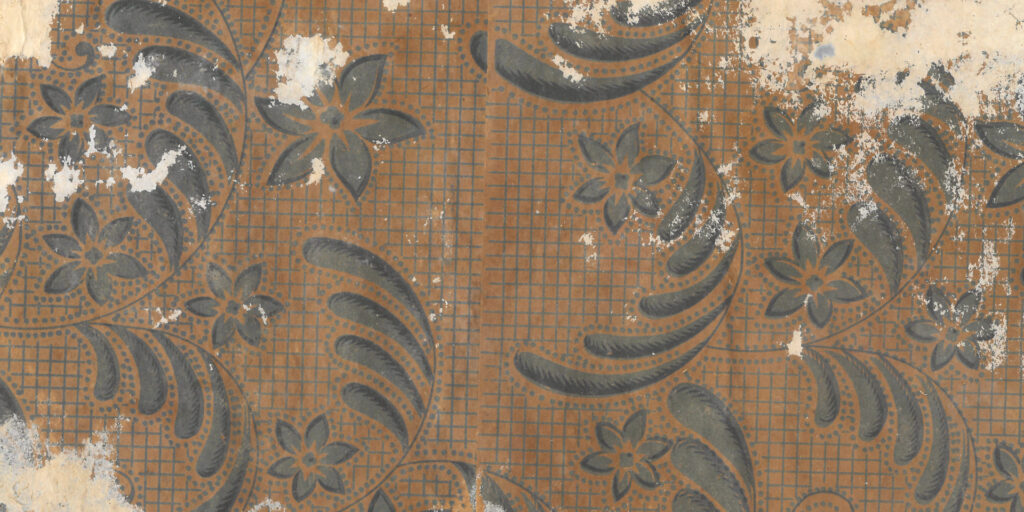
(Source : Gosate Collection)

(Photo by Gosate 2023)
4. The Function of Vermicular Texture
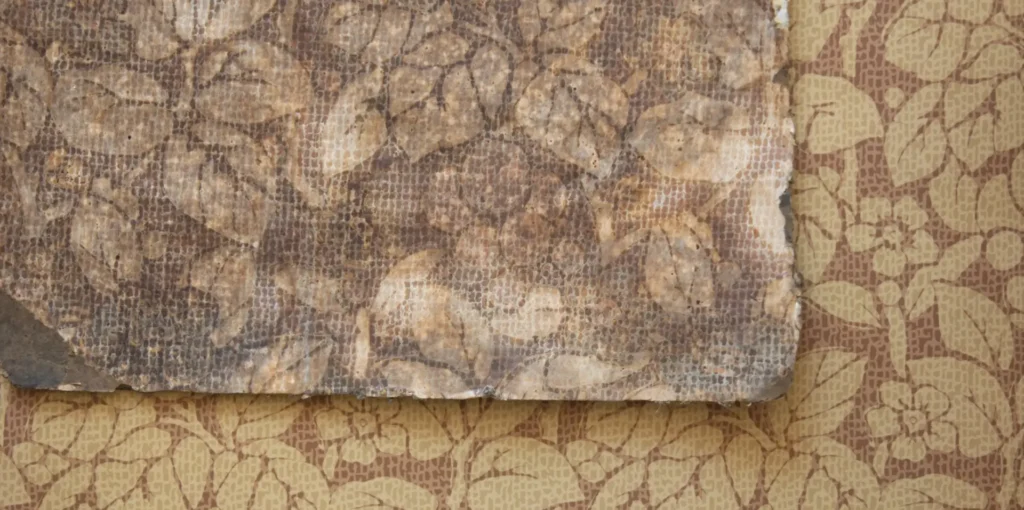
The vermicular texture filling the background of the pattern derives from the “Sanitary Wallpaper” technology developed in late 19th-century Britain. This texture served a functional purpose — concealing ink irregularities produced during the roller printing process — while also enriching the visual surface of plain walls through the diffuse reflection of light.
This micro-texture is linked to the hygiene discourse of the era: the modern ideal of a “clean and easily maintained space.” Still in use as a manufacturing technique in 1946, it represents a case in which a technical requirement was transformed into an aesthetic form.

The Significance of This Wallpaper
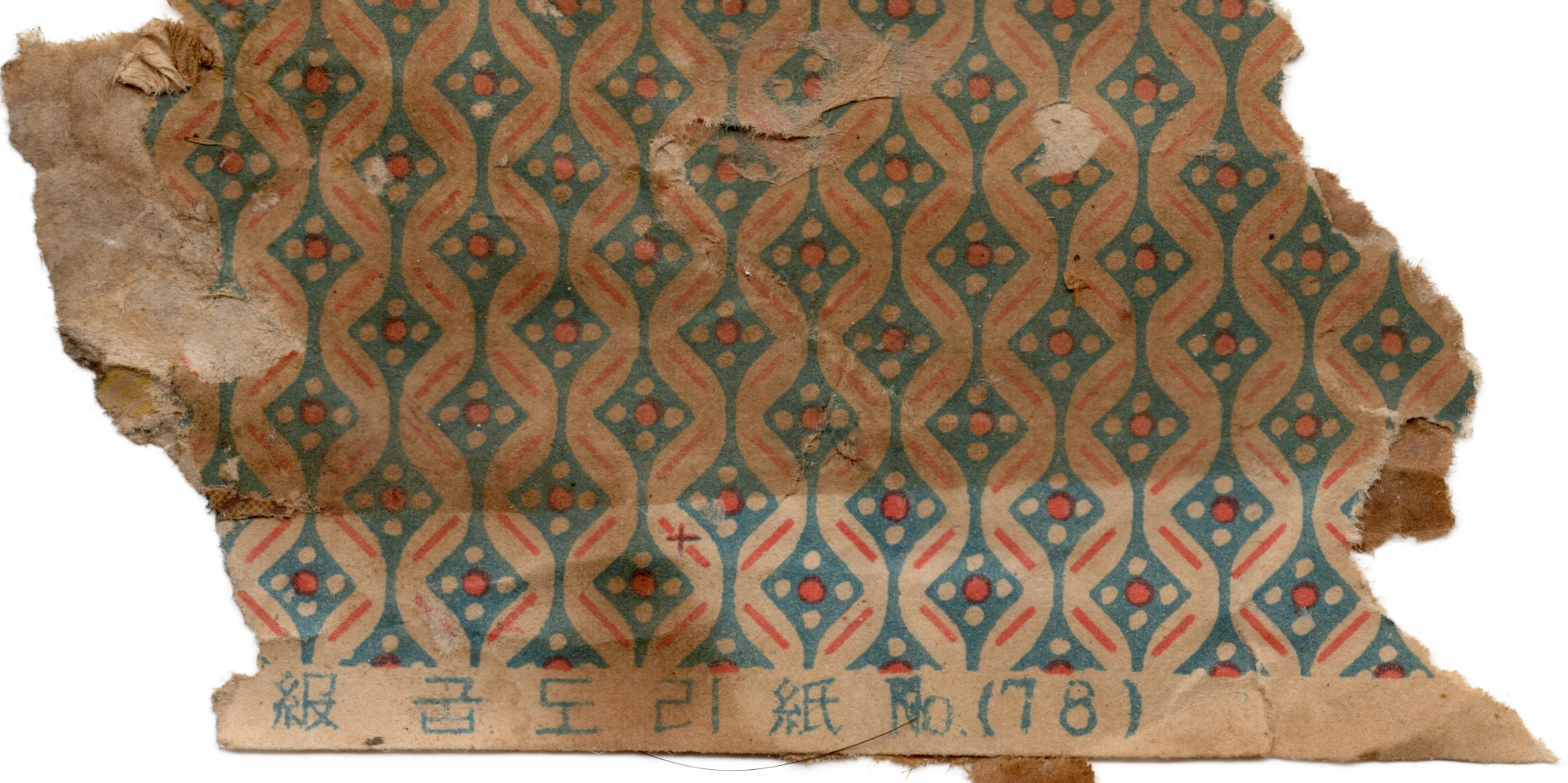
This wallpaper from 1946 illustrates a convergence in design history: Byzantine geometry traveling through Western Europe or Russia, passing through Japan, Shanghai, and Manchuria, before coming to rest on the Korean peninsula. The process by which Western classical forms were re-edited and fused with Northeast Asian traditional motifs offers a vivid window into how modern design in Northeast Asia selectively absorbed and reinterpreted foreign elements. Tracing this pattern lineage will serve as an occasion to reassess the archival value of wallpaper as a primary source for the study of modern Korean domestic history and interior culture.
Copyright © 2026 Gosate Archive.
All Rights Reserved.
- All text and scholarly analysis are the intellectual property of the author.
- All photographs marked “Gosate Collection” or “Photo by Gosate” are the copyright of GOSATE. Reproduction, copying, or distribution without prior consent is strictly prohibited.
- Historical images cited from external sources are subject to their respective copyright holders or public domain provisions.
Inquiries: contact@gosate.kr
More from this era