
From Lyon to the Joseon Hanok: The Baroque Damask Scaled Down for the Ondol Room
1. A Design Lineage: Lyon's Silk Blooms on Paper What first draws the eye in this wallpaper is the repeating small vase and the graceful plant curves enveloping it. Leaves and flowers rise from…

1. A Design Lineage: Lyon’s Silk Blooms on Paper
What first draws the eye in this wallpaper is the repeating small vase and the graceful plant curves enveloping it. Leaves and flowers rise from the wide-mouthed vase like a candelabra, while plump acanthus- or grape-leaf forms billow outward on either side to embrace it. Moving downward, a scaled motif appears — a distinctive fruit with a scalloped surface and protruding tip, sitting somewhere between pineapple, pomegranate, and pine cone: the classic Western decorative symbol of abundance.
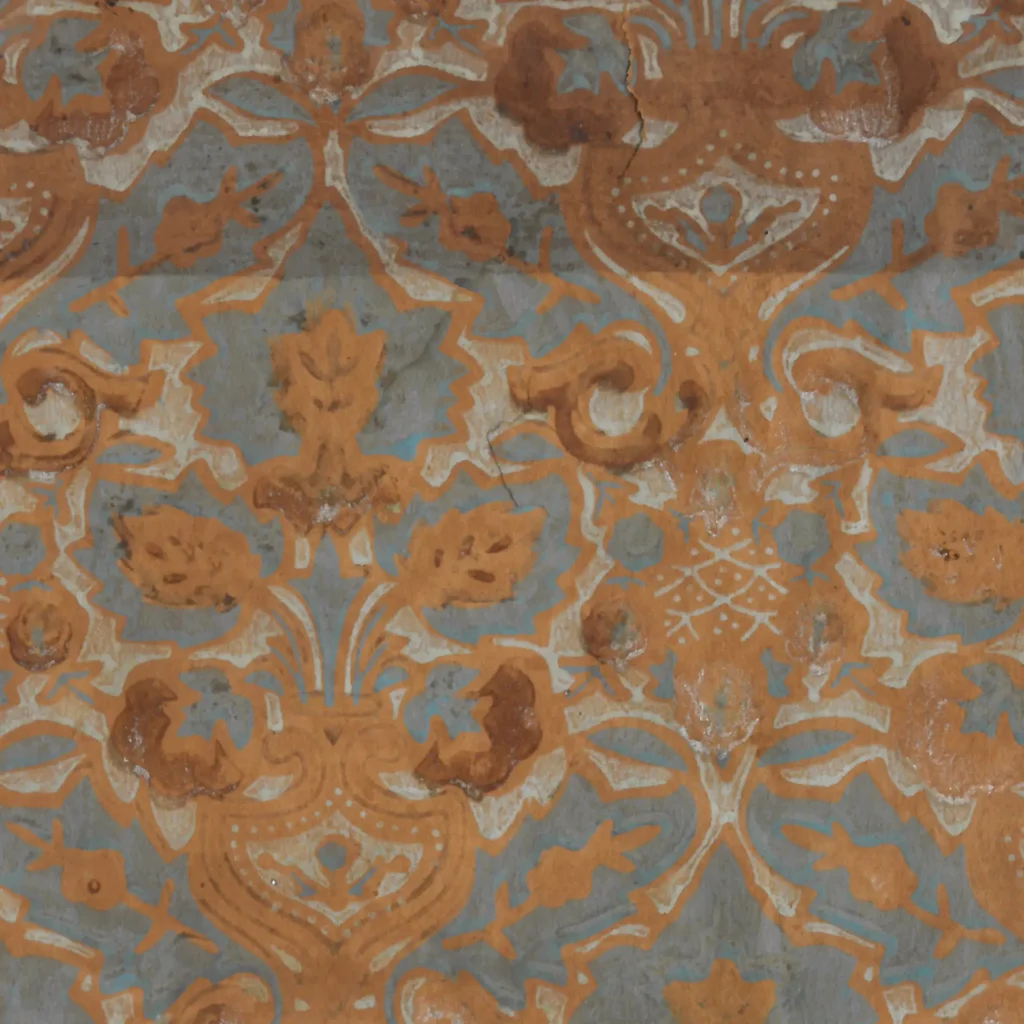
This vase, plants, and fruit — forming a single bilateral symmetrical module that covers the entire wall — is the grammar of the damask. Originally born in the silk factories of 17th–18th century Italy and Lyon, France, damask fabric was the emblem of splendor in royal and aristocratic spaces. The robust S- and C-curves, the generously swelling leaves, the combination of vase and fruit: this is the classic vocabulary of Baroque-Rococo ornament. After the Industrial Revolution of the 19th century, this aristocratic textile descended onto paper and into the middle-class parlor — and this wallpaper, found in a 1937 Joseon hanok, sits at the far end of that long lineage. The material has changed from silk to pulp paper, but the candelabra stem rising from the vase and the abundant pineapple fruit testify that this pattern’s roots lie not in Gothic or Renaissance but in the brilliant Baroque of Lyon.
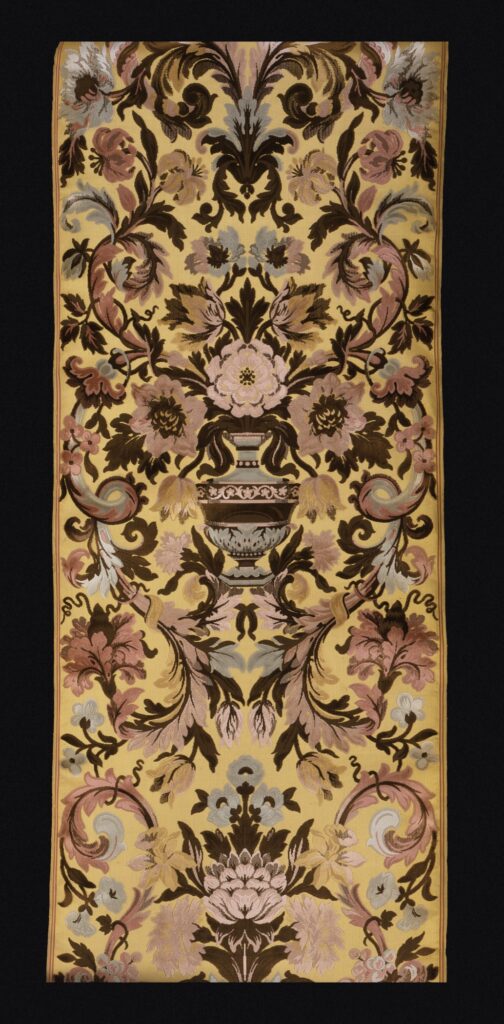
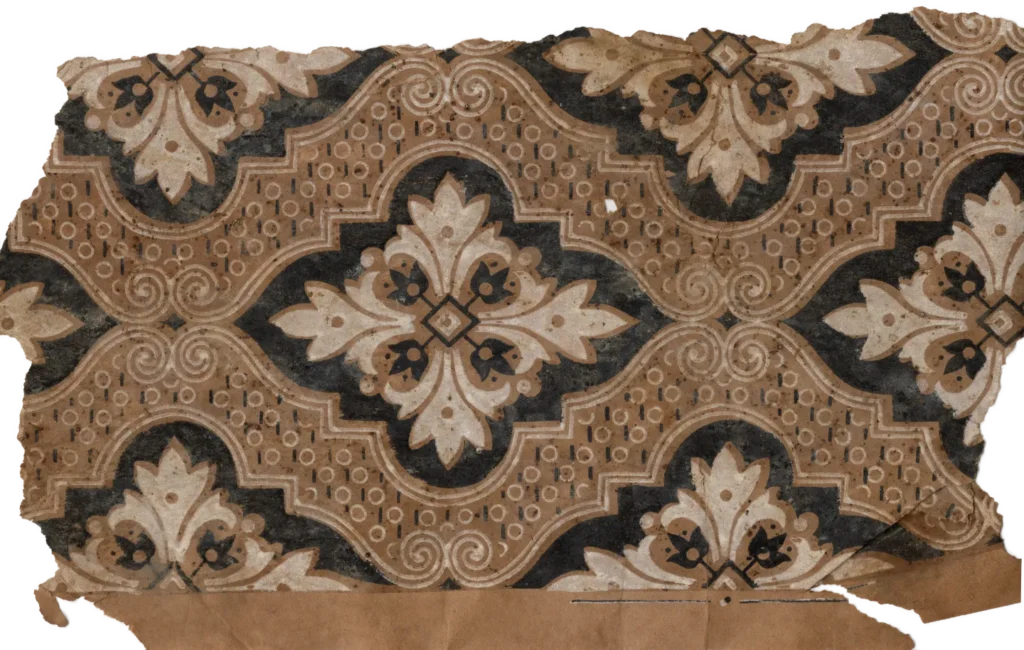
Silk and linen blended fabric by Prelle, made circa 1876. Housed at the Los Angeles County Museum of Art.
2. The Transformation of Scale: A ‘Joseon Damask’ Reduced to a Handspan
Yet the truly fascinating aspect of this wallpaper is not that it copied the European damask but that it systematically recalibrated it. The most significant change is scale. The original damask that decorated European salons and aristocratic residences had modules often exceeding 30–40 cm. The module of this wallpaper has been reduced to something smaller than a single handspan. This is a direct response to the physical conditions of the hanok bang (room) — low ceilings and limited floor area. Had the grand Baroque curves arrived full-sized into a small hanok room, they would have overwhelmed the space or appeared grotesque. The manufacturer therefore compressed the motif into something small and dense, so that the wallpaper would function not as a dominant visual statement but as a quiet background — like a lace curtain or woven textile.
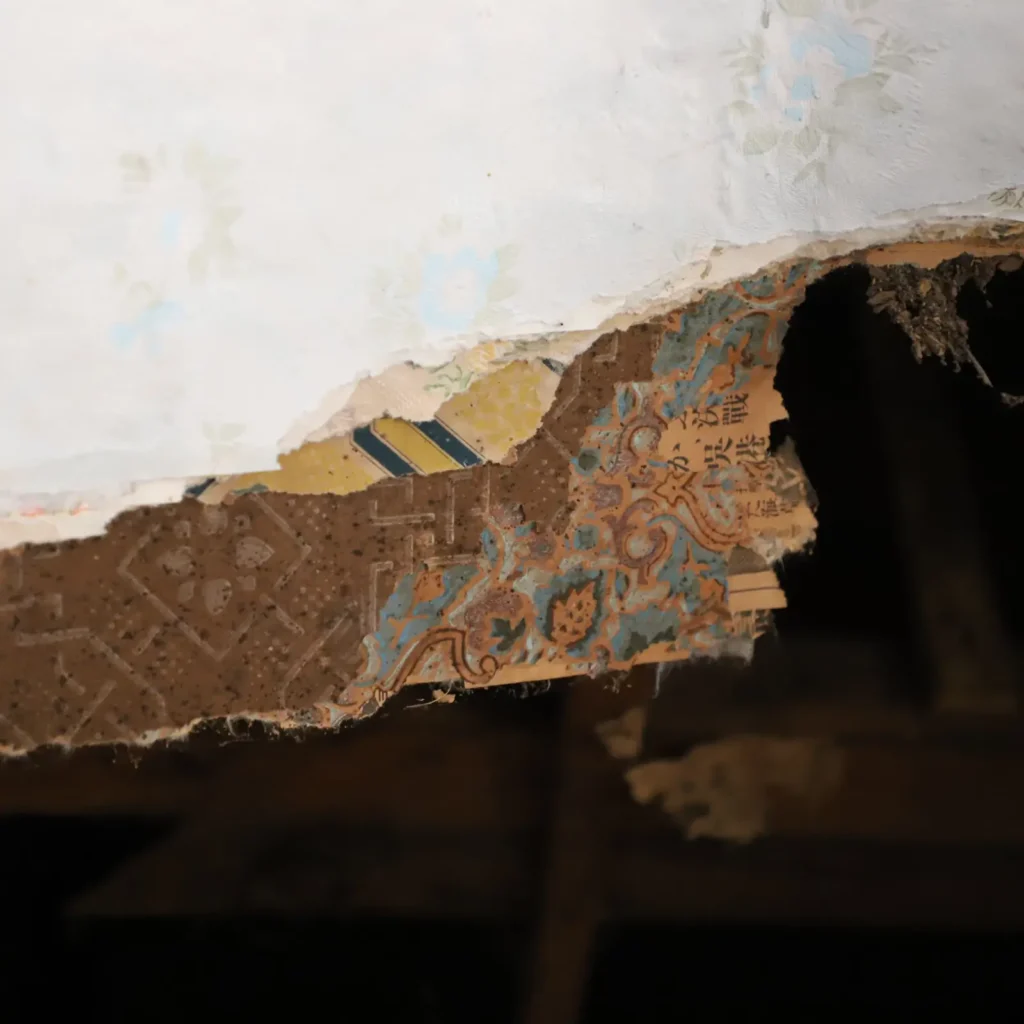
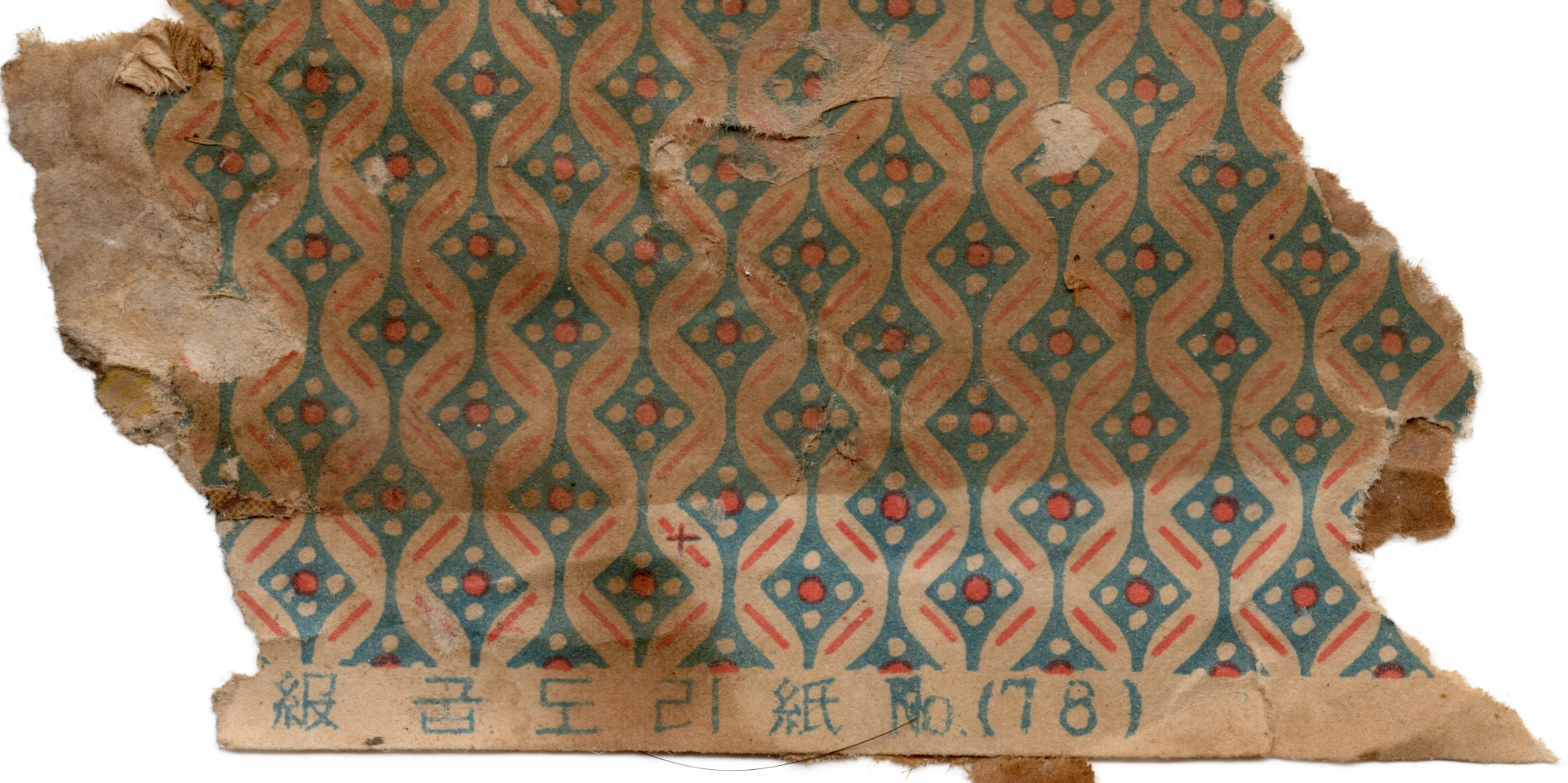
(Photo by Gosate 2023)
3. Comparison and Evidence: The India Version vs. the Joseon Version — the Secret of Scale
That this wallpaper is not a simple import but a deliberately targeted product calibrated to Joseon’s domestic environment becomes clear through comparison with a Japanese wallpaper catalogue sample acquired by GOSATE from India.
The India catalogue contains a pattern iconographically related to this wallpaper — a sibling design. But between the two, a decisive difference exists: scale and color. The India export sample features larger motifs and a vivid palette approaching primary colors; the wallpaper found in the Joseon hanok has modules smaller than a handspan, and a palette restrained to a calm two-tone of grey-blue and white.
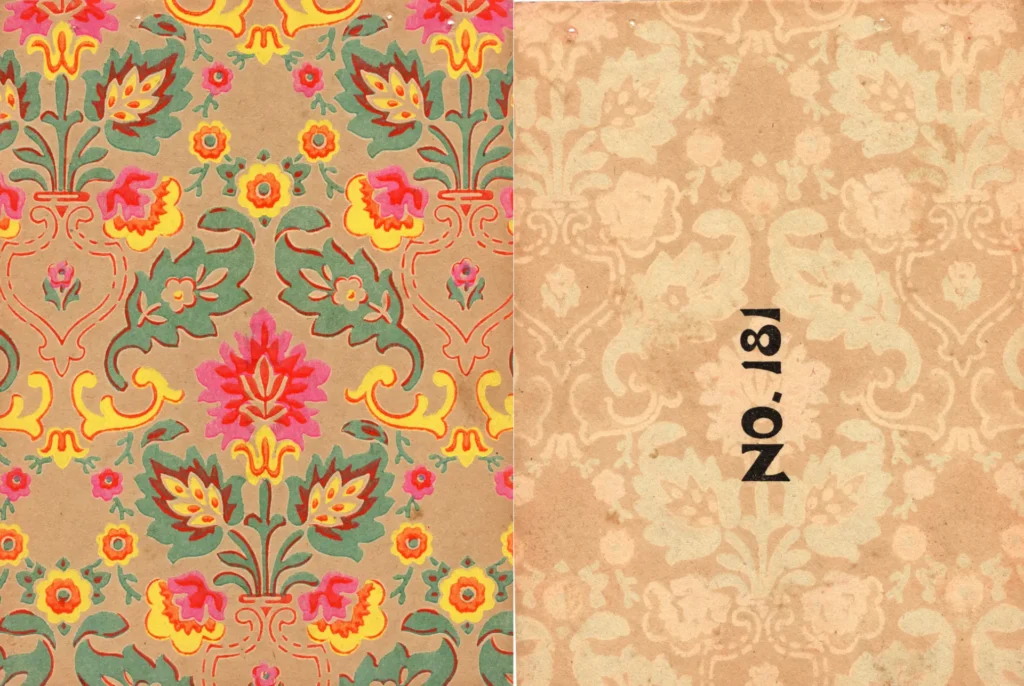
(Source : Gosate Collection)
This strongly suggests that Japanese paper manufacturers differentiated their product lines by export market according to the domestic architecture of each destination. For the high-ceilinged, spacious interiors of upper-class Indian residences and colonial-style buildings, bold large-scale patterns were supplied; for the low-ceilinged, narrow ondol rooms of the Joseon hanok, a separately developed miniaturized version was produced. Rather than allowing the large Baroque curves to overwhelm a small room, the manufacturer deliberately reduced the motif and stripped back the color for the Joseon market — a conscious localization strategy to make the wallpaper read as a soft background textile rather than a dominating statement.
4. Connected Across Time: From the Weavers of Lyon to the Inner Room of Gyeongseong
In the end, this wallpaper is a hybrid: following the grammar of 17th-century European damask, borrowing the industrial capacity of 1930s Japan, and shrinking itself to fit the particular spatial conditions of the Joseon hanok.
An invisible thread connects across this thin sheet of paper. It begins at the hands of a Lyon silk weaver, passes through a Victorian-era British wallpaper factory, moves through a Meiji-period Japanese printing house, and arrives at a Joseon household owner papering the walls of a newly built home in 1937. The difference in scale between the India and Joseon versions reveals how acutely the manufacturers of the time perceived and targeted the distinct domestic cultures of different Asian markets. The small pineapple nestled beneath the vase is, in the end, a symbol of bespoke abundance — one that willingly made itself smaller to fit the Joseon inner room.
Copyright © 2026 Gosate Archive. All Rights Reserved.
All Rights Reserved.
- All text and scholarly analysis are the intellectual property of the author.
- All photographs marked “Gosate Collection” or “Photo by Gosate” are the copyright of GOSATE. Reproduction, copying, or distribution without prior consent is strictly prohibited.
- Historical images cited from external sources are subject to their respective copyright holders or public domain provisions.
Inquiries: contact@gosate.kr
More from this era