
Silkless Silk Walls — Korean Damask Wallpaper of the 1970s
Printed in only two colors on pulp paper, this 1970s Korean wallpaper compresses the long European damask tradition into an affordable domestic surface.
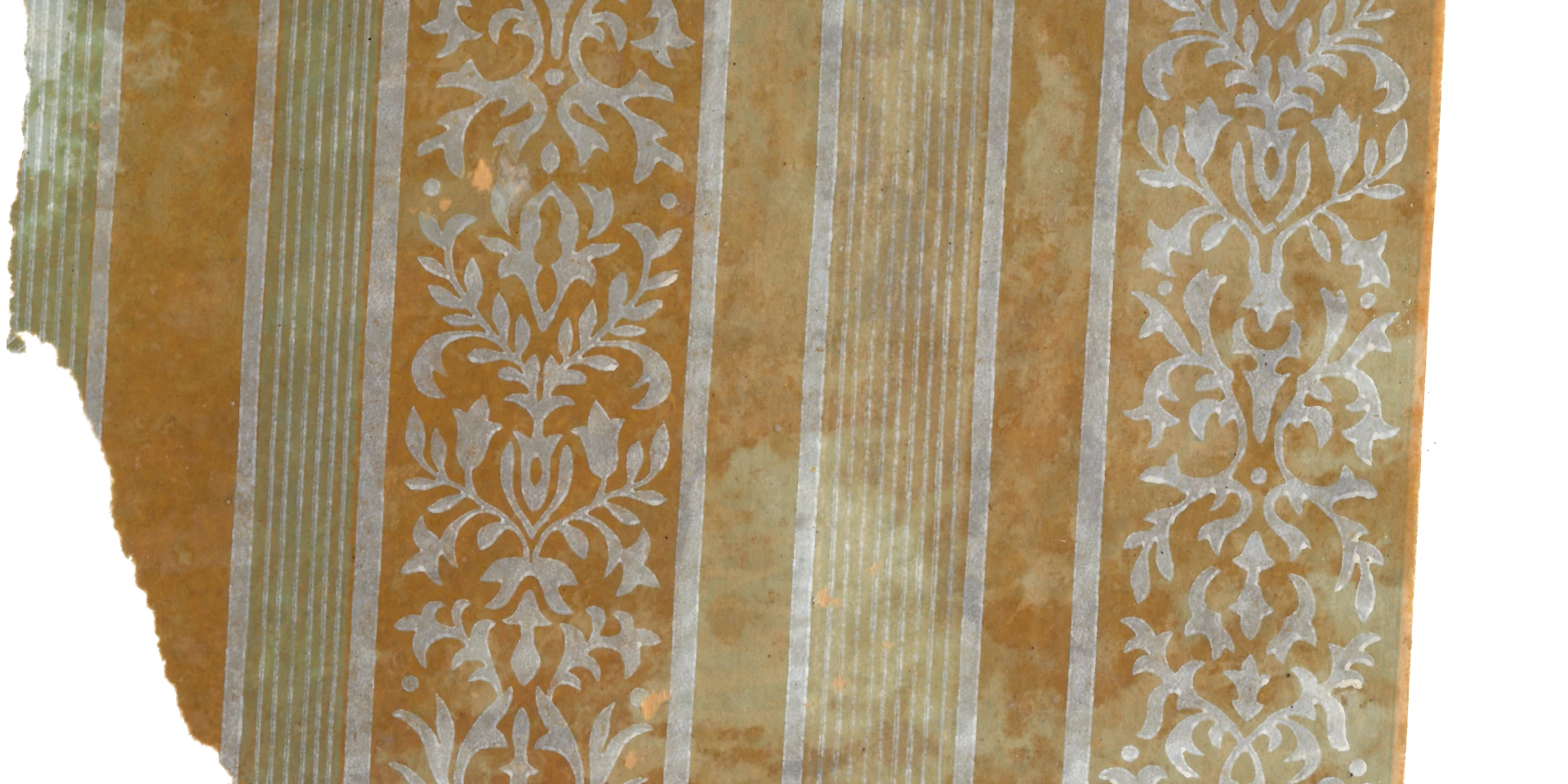

(Source : Collection of Gosate)
A Palace on Pulp Paper
At first glance this early 1970s Korean wallpaper feels both familiar and strange. White and khaki inks form vertical bands over pulp paper. Within those bands, mirrored scroll leaves repeat like woven ornament, while thin lines divide the stripes.
Anyone familiar with European interiors will recognize the type: the damask stripe, one of the classic formats of European wallpaper.
From Damascus to Korea
The word damask comes from Damascus. It originally described a silk-weaving technique in which matte and glossy surfaces formed patterns in the cloth. Through Mediterranean trade, damask became a luxury material in European palaces and aristocratic interiors.
From the eighteenth century onward, paper wallpaper offered a cheaper substitute for households that could not afford silk wall hangings. The damask stripe, with medallions framed by vertical bands and pinstripes, became a standard form.
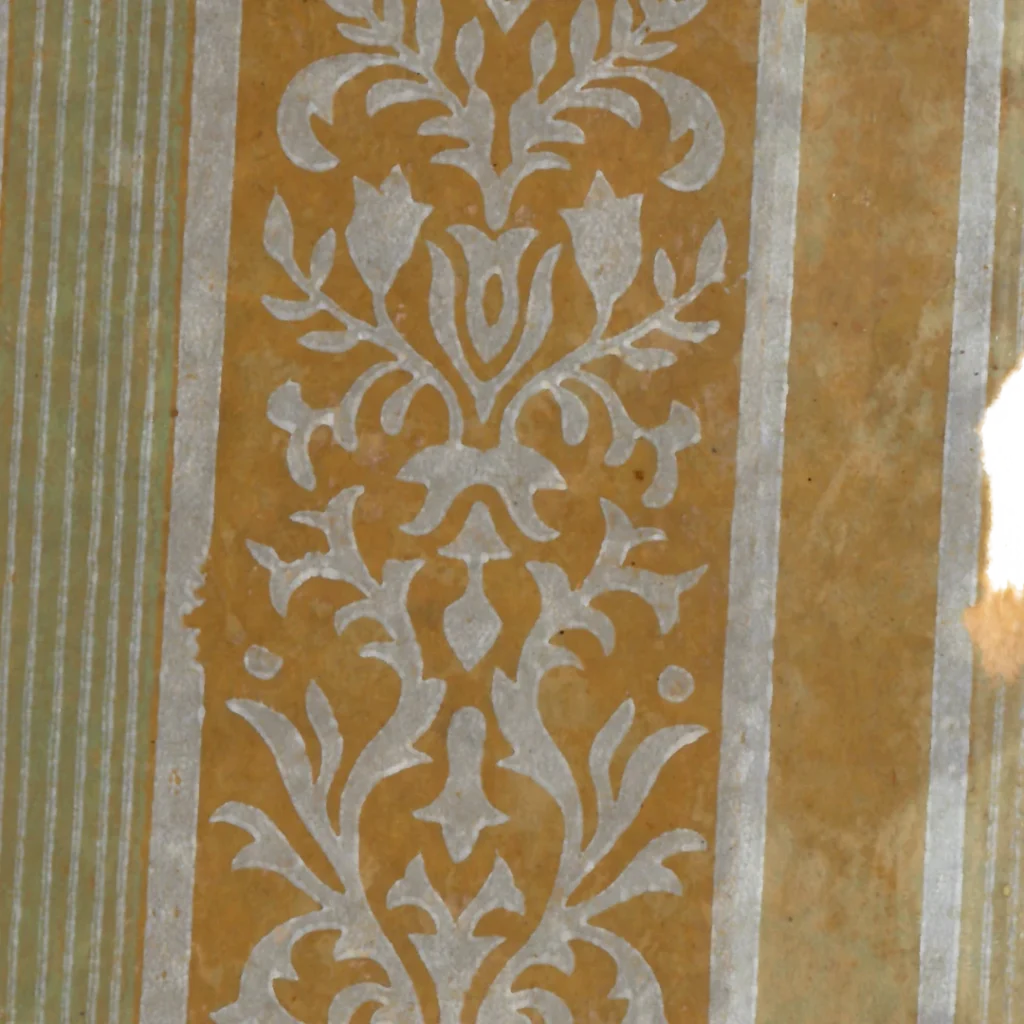
The motifs here — acanthus-derived scrolls, palmettes, tulip-like buds, and mirrored symmetry — come directly from that European decorative tradition. There is little that reads as East Asian.
A Translation in Two Colors
Yet this wallpaper is not a simple copy. European damask wallpapers often tried to imitate the depth of silk, flocking, gilding, and jewel-like color. This Korean version compresses the entire language into two inks and the natural color of pulp paper.
That material limitation produces its own visual character. If European damask spoke of wealth, this wallpaper speaks of aspiration, adaptation, and the desire to bring a formal Western interior language into ordinary Korean homes.
It is silk without silk, a palace grammar printed for everyday rooms.
The Promise of Damask
Damask was historically associated with silk, wealth, and formal rooms. A damask stripe on wallpaper therefore carried a promise: it could make an ordinary wall participate in a language of European refinement. The promise mattered even when the material was inexpensive.
This Korean wallpaper makes that promise under strict material limits. There is no woven silk, no flocked pile, no metallic depth, and no expensive color layering. There is pulp paper, a natural ground, and two printed inks.
That limitation does not make the paper less meaningful. It shows how global decorative prestige was translated into the conditions of Korean mass production. The wallpaper does not reproduce damask as material; it reproduces damask as an idea.
A Domestic Western Style
In Korea of the late 1960s and 1970s, Western-style houses and living rooms increasingly became aspirational spaces. Furniture, curtains, wallpaper, and lighting all helped produce a new image of domestic modernity. A damask stripe could belong naturally to that new interior language.
The pattern’s vertical bands would have made walls appear more orderly and taller. The symmetrical motifs gave a sense of formality. Even in a modest room, the paper could suggest the atmosphere of a salon or reception room.
Translation, Not Imitation
What makes the wallpaper Korean is not a visible traditional motif. It is the act of translation itself. European damask was compressed into a cheaper printing system, adjusted to local materials, and installed in Korean homes that were negotiating new ideas of taste.
In that sense, this is a “silkless silk wall.” It does not hide its paper nature. Instead, it shows how paper could democratize the image of luxury.
Copyright © 2026 GOSATÉ Archive. All Rights Reserved.
- All text and scholarly analysis are the intellectual property of the author.
- All photographs marked “Gosate Collection” or “Photo by Gosate” are the copyright of GOSATE. Reproduction, copying, or distribution without prior consent is strictly prohibited.
- Historical images cited from external sources are subject to their respective copyright holders or public domain provisions.
Inquiries: contact@gosate.kr
More from this era