
From London to Gangjin Byeongyeongseong: A Design Journey Embedded in a 1944 Wallpaper
1. Texture Analysis: The Illusion of 'Fabric' Woven onto Paper The original Japanese colonial-era wallpaper 'Soonae,' discovered in an early 1940s historic home near Byeongyeongseong Fortress in Gangjin, South Jeolla Province, alongside the GOSATE…
1. Texture Analysis: The Illusion of ‘Fabric’ Woven onto Paper

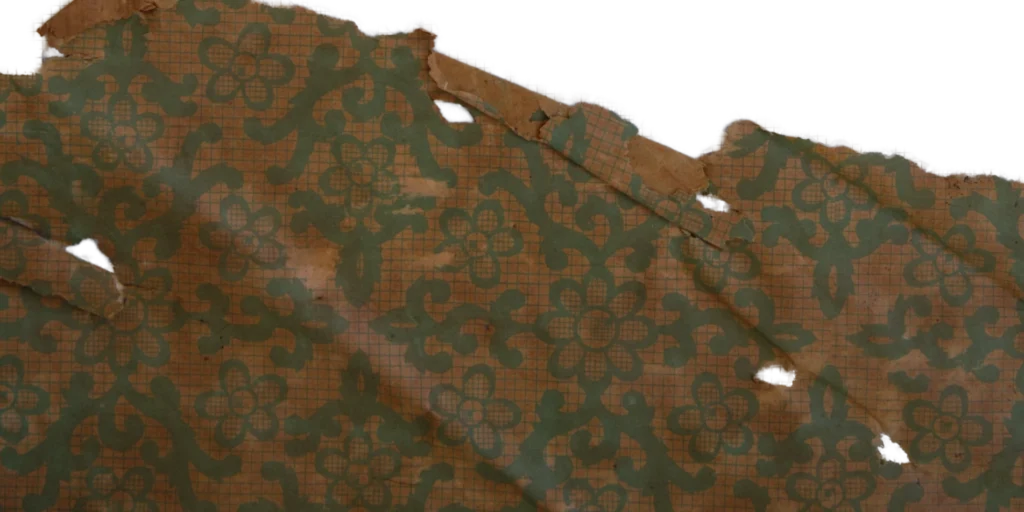
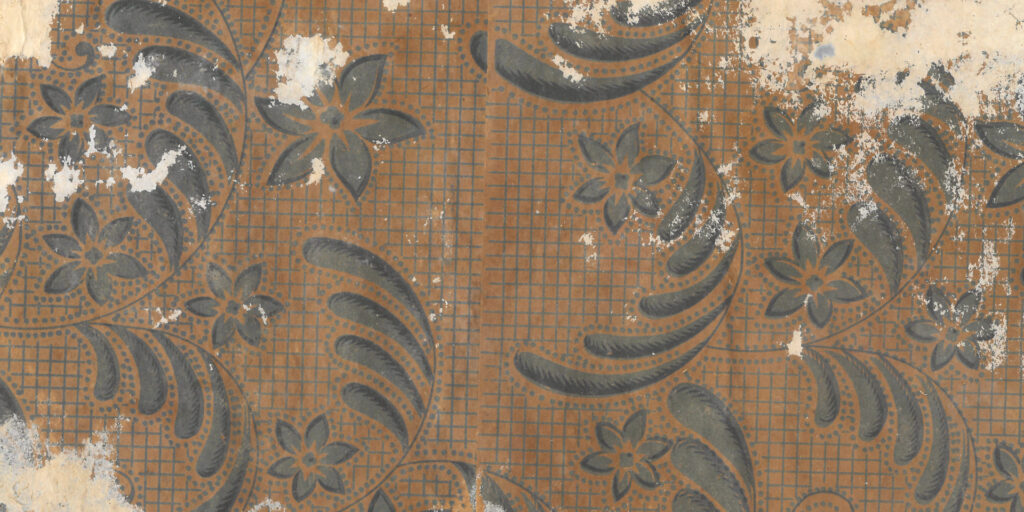
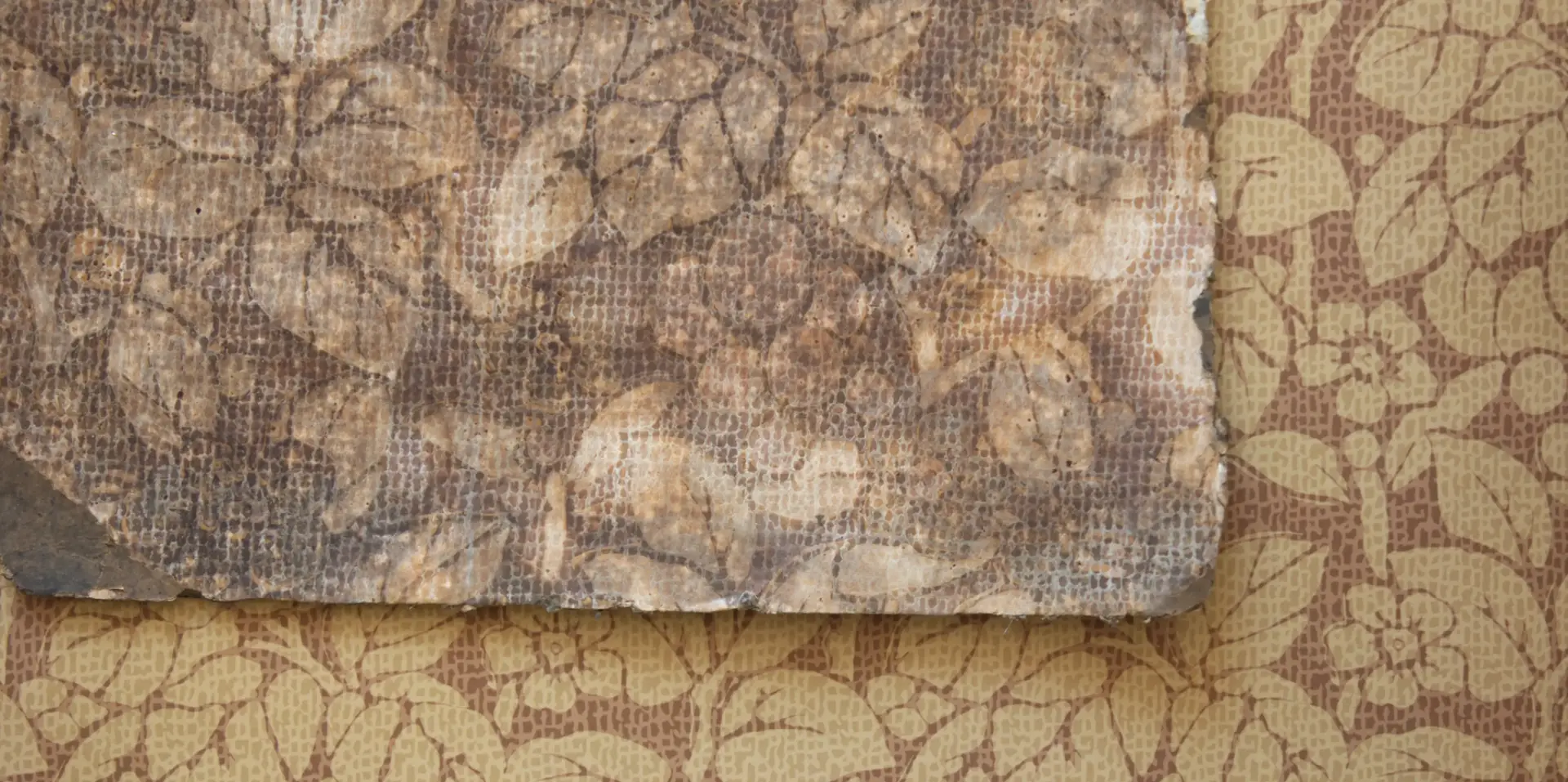
The most striking feature of this wallpaper is undoubtedly its grid mesh texture. This pattern appears to employ a “Textile Imitation” technique that was popular in the West — particularly in Britain — from the 1910s through the 1930s.
Western wallpaper manufacturers of the era sought to give flat paper a sense of three-dimensional depth. To achieve this, they would first print a grid pattern mimicking the texture of canvas, linen, or coarse linen fabric onto the background, before layering floral motifs on top. The intent was to create the illusion, once hung on a wall, that the entire surface had been finished with luxurious tapestry or needlepoint embroidery.
The 1943 wallpaper fragment discovered here shows that the pigments of its once-vivid floral motifs — likely organic reds and greens — have oxidized and faded with time. What remains is the relatively durable background grid pattern and the shadowed outlines of the overall design.


(Source: Gosate collection)
2. Design Lineage: From William Morris to East Asia
The origins of this style trace back to William Morris and the Arts and Crafts Movement in late 19th-century Britain. This tradition, which valued nature-derived patterns and handcrafted texture, entered the mainstream in the 20th century through its fusion with mechanized surface printing technology capable of mass production.

The designs of William Morris, a leading figure of the Arts and Crafts Movement, are characterized by organic arrangements of natural forms and dense, richly layered compositions. This aesthetic would later become the root of the “Tapestry Style” wallpapers mass-produced in the 1920s and 1930s.
Pink and Rose by William Morris (1834-1896). Original from The MET Museum. Digitally enhanced by rawpixel.
Surveying European archives of the same period confirms that this style of floral wallpaper on a grid background flourished as an international style, spreading from Britain across Scandinavia and beyond. In other words, this wallpaper hung in a home in Gangjin was aligned with the very cutting edge of global design in its time.
3. Tracing the Route: Empire, Colony, and the Merchant’s Path
Given the date of 1943 and the location of Gangjin, two possibilities can be considered regarding the origins of this wallpaper.
The most likely hypothesis is that it was a British-style imitation produced via Japan. From the 1930s onward, Japanese manufacturers operating under a wartime economy actively replicated British designs, producing “Western Style” wallpapers and supplying them to modern homes and commercial spaces in colonial Joseon.
However, the possibility of direct importation cannot be entirely ruled out. Gangjin’s Byeongyeongseong area was traditionally a commercial hub where goods converged, and one of the channels through which Western goods entered following the opening of Korea’s ports. It is entirely plausible that local elites or merchant-class residents sought out original British wallpapers — arriving through Gyeongseong (Seoul) or Japan — to decorate their spaces, satisfying a modern desire for conspicuous refinement.

4. Conclusion: The Strata of an Era Held in a Single Fragment of Wallpaper
In conclusion, this wallpaper discovered near Gangjin Byeongyeongseong can be understood as a fragment of modern interior culture — one that originated in the British Tapestry Style of the 1930s and arrived in a provincial Korean city in 1943, carried through Japan’s industrial reproduction networks or along the trade routes of merchants.
Though its colors have long faded, leaving only the grid and the shadow of the overall pattern, what remains is a fossil of aspiration — the longing of the people of that era for a “Western space wrapped in warm, soft fabric.” Beyond the recovery of lost patterns that GOSATE pursues, this wallpaper will stand as a precious archival source for reconstructing the everyday life and aesthetic sensibility of its time.
Copyright © 2026 Gosate Archive. All Rights Reserved.
- 텍스트 및 분석: 본문의 모든 텍스트와 학술적 분석에 대한 권리는 저자에게 있습니다.사진 자료: ‘Gosate Collection’ 및 ‘Photo by Gosate’로 표기된 모든 실물 촬영 이미지의 저작권은 고사테에 있습니다. 사전 협의 없는 무단 전재, 복사, 배포를 금합니다.인용 자료: 별도로 출처가 명시된 역사적 도판 및 인용 이미지는 해당 저작권자 또는 퍼블릭 도메인(Public Domain) 규정에 따릅니다.
More from this era