Folding the Screen onto the Wall: The Cloud Cartouche and the Pine-Crane Wallpaper of the 1960s
1. An Organic Structure in Which Small Folding Screens Wrap the Entire Wall Each repeating unit of this wallpaper is composed like a compressed panel of a byeongpung(병풍) (folding screen). What first arrests the…

1. An Organic Structure in Which Small Folding Screens Wrap the Entire Wall
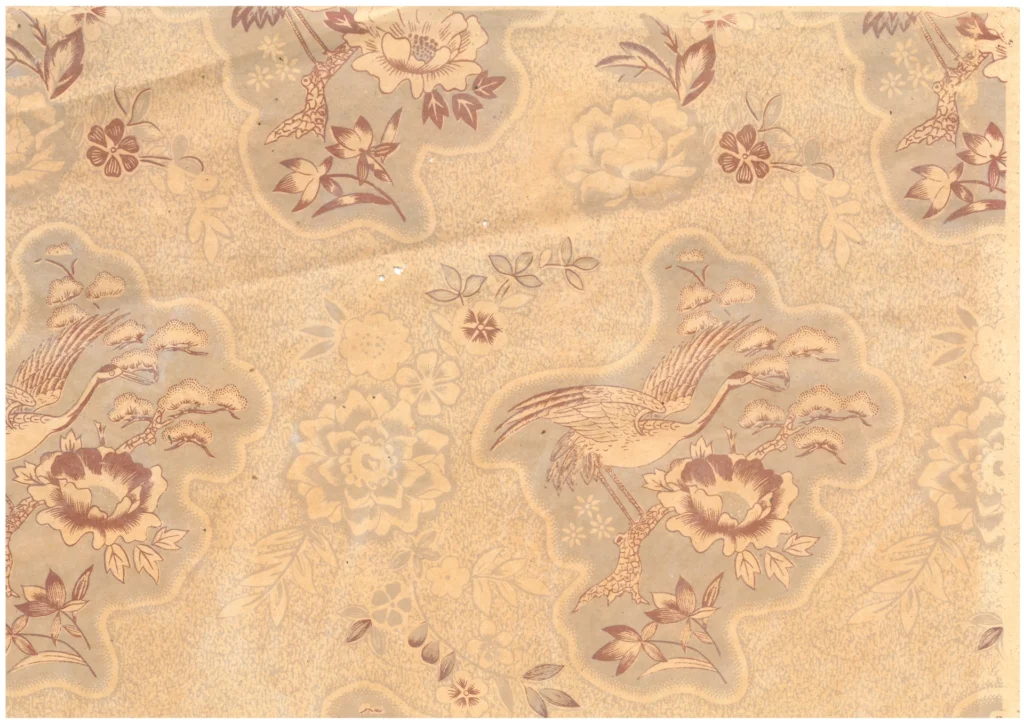
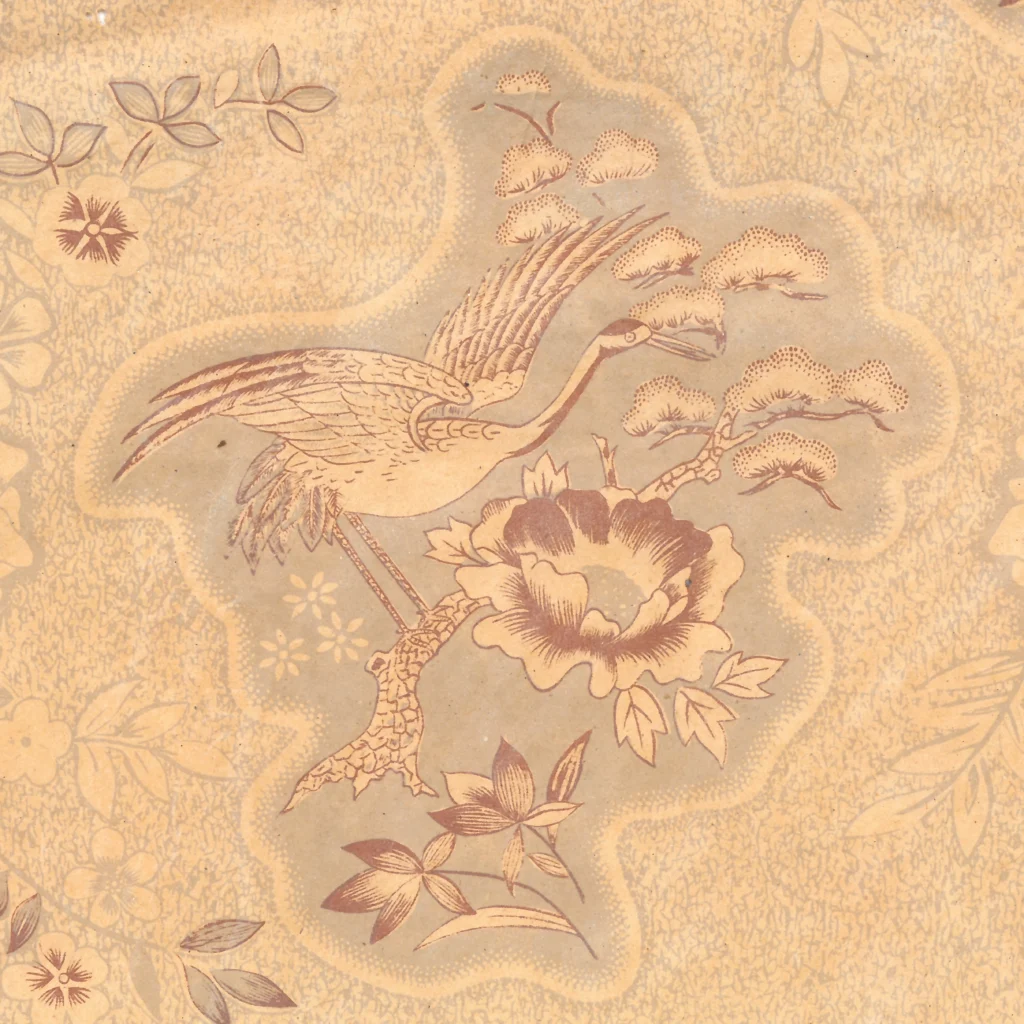
Each repeating unit of this wallpaper is composed like a compressed panel of a byeongpung(병풍) (folding screen). What first arrests the eye is the cloud-shaped outline whose edges ripple and undulate in jagged waves. This contour evokes a fragment of cloud, while simultaneously functioning as a cartouche — the framing device used in painting to demarcate the boundary of a pictorial field — generating a distinctive formal beauty all its own.
(Source: Collection of Gosate)
The iconography arranged within this frame follows a classic composition laden with auspicious meaning (gilsang, 吉祥). At the top, a crane perches on a pine branch with wings half-spread; at the bottom, a single fully-bloomed peony fills the lower register. The combination of pine, crane, and peony is a canonical repertoire of Korean and Northeast Asian decorative art, symbolizing longevity and prosperity — familiar imagery encountered in folk painting screens and mother-of-pearl inlaid furniture alike. The branches of plum blossom and wildflowers filling the surrounding space further increase the visual density while layering on additional auspicious meaning.
(Source: Collection of Gosate)
(Source: Collection of Gosate)
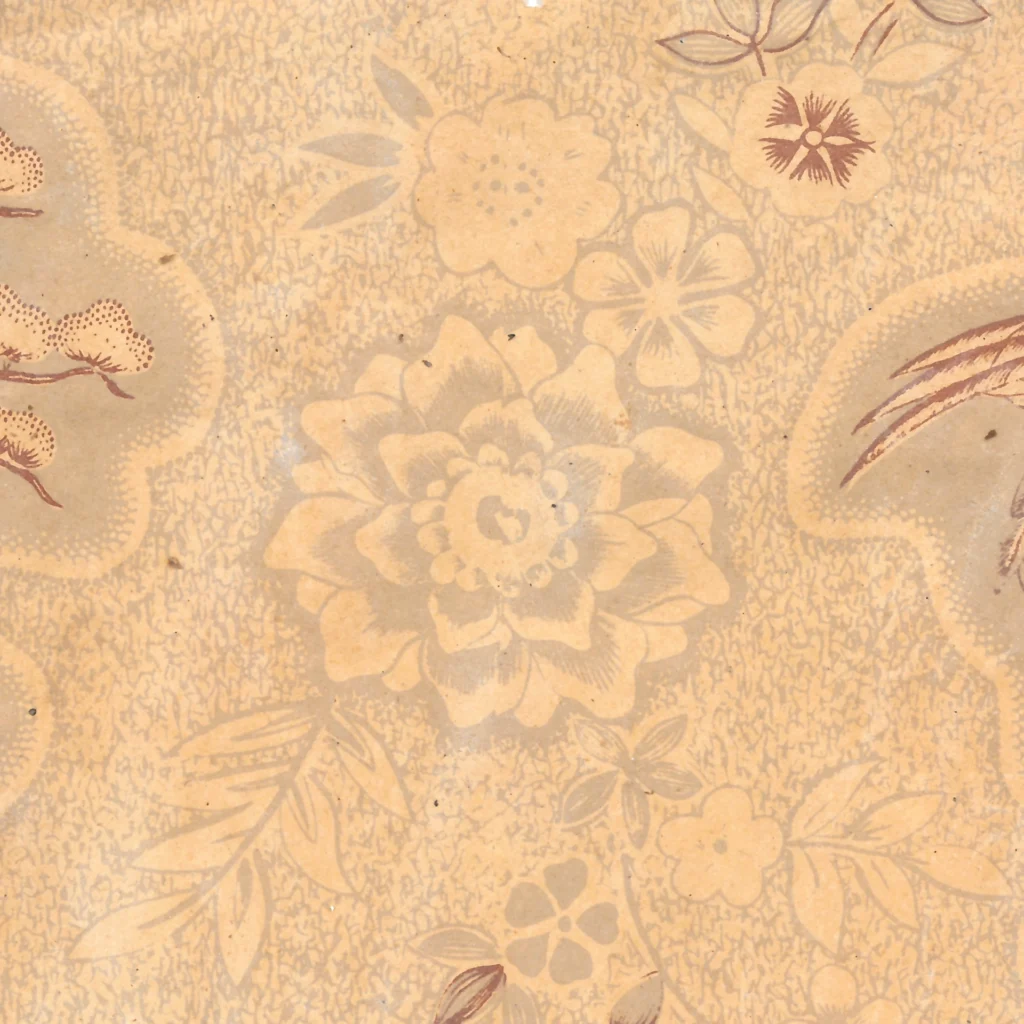
The manner of repetition is equally fascinating. Although the cloud cartouches are arranged on a regular grid, their organic forms prevent the repeat unit from reading as mechanical. Small flowering branches are scattered outside the cartouches as well, so that viewed from a distance the whole reads as a vast mural of continuously joined folding screens. When used to fill the broad wall of a living room or inner chamber, this produces a remarkable decorative effect — alleviating monotony and elevating the dignity of the space.
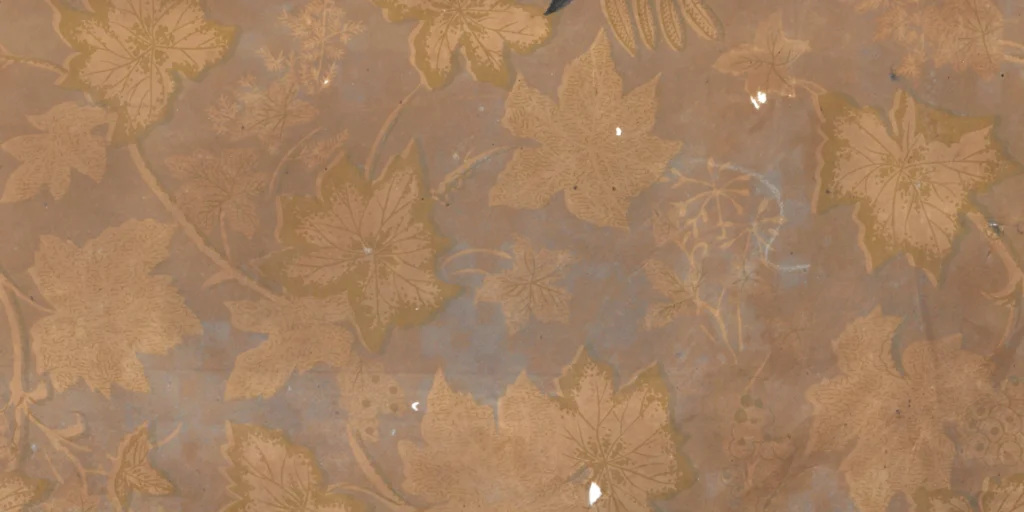
Particularly noteworthy is the way the printed layers are separated to create a sense of depth. A fine stipple texture in the background naturally conceals wall irregularities and grime; over this, a tonal overlay of the cloud outline is added to build depth. The crane and peony are printed with multiple stages of light and shadow separated by layer, then finished with a dark outline laid over all — producing a painterly effect of considerable sophistication.
2. The Lineage of the Jangji Design and Its 1960s Redrawing
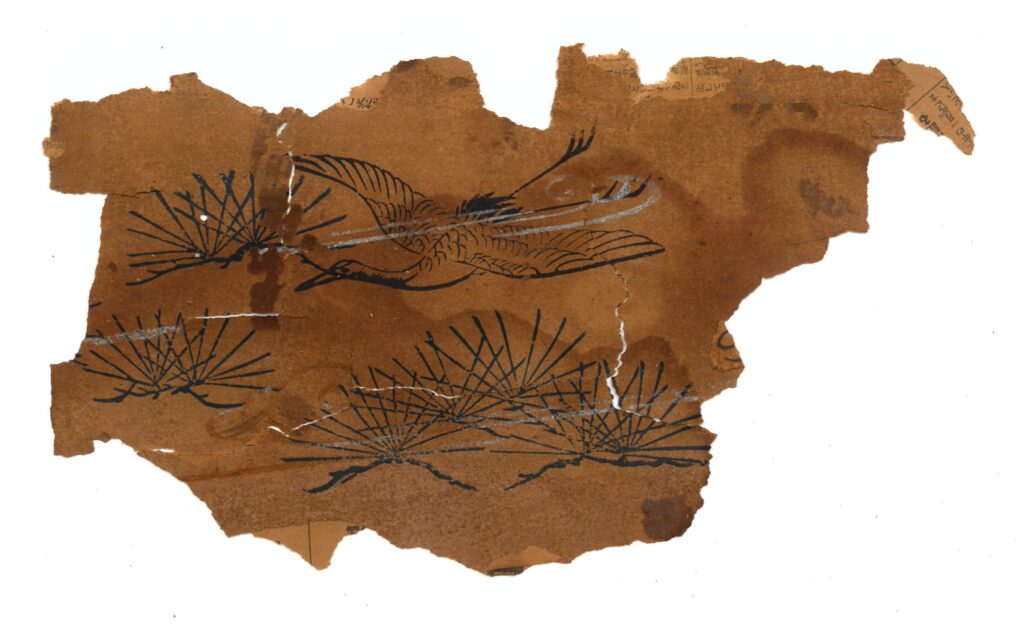
Tracing the iconographic lineage, this wallpaper connects in part to the Japanese-produced pine-crane (songhakdo) designs used on jangji (decorative door paper) during the Japanese colonial period. Traces of modern Japanese decorative style are visible in the proportions of the crane's body and the treatment of the pine trunk — and indeed, similar pine-crane compositions on jangji have been found in hanok interiors dating to the 1930s.
(Source : Gosate Collection)
Yet this wallpaper is not a simple copy of a prior design. Its singular value lies in the fact that it is a redrawn original, passed through the hands of a Korean designer. The line of the pine trunk has moved away from the stiff, straight rendering of Japanese painting toward the rounder, softer curves characteristic of Korean folk painting (minhwa), and the arrangement of the peony petals has been rendered with greater naturalness. On the roots of a jangji culture introduced during the colonial period, a new "wallpaper of our own" was drawn — one calibrated to the sensibility of Korean life in the 1960s.
Of particular note is that GOSATE's original of this wallpaper is preserved not in roll form but in sheet unitscorresponding to the dimensions of traditional paper. This testifies that, even into the early 1960s, the hanji format and the traditional method of composing wall surfaces had not entirely disappeared. Each sheet functioning like a single pictorial panel of jangji, filling the wall one frame at a time.
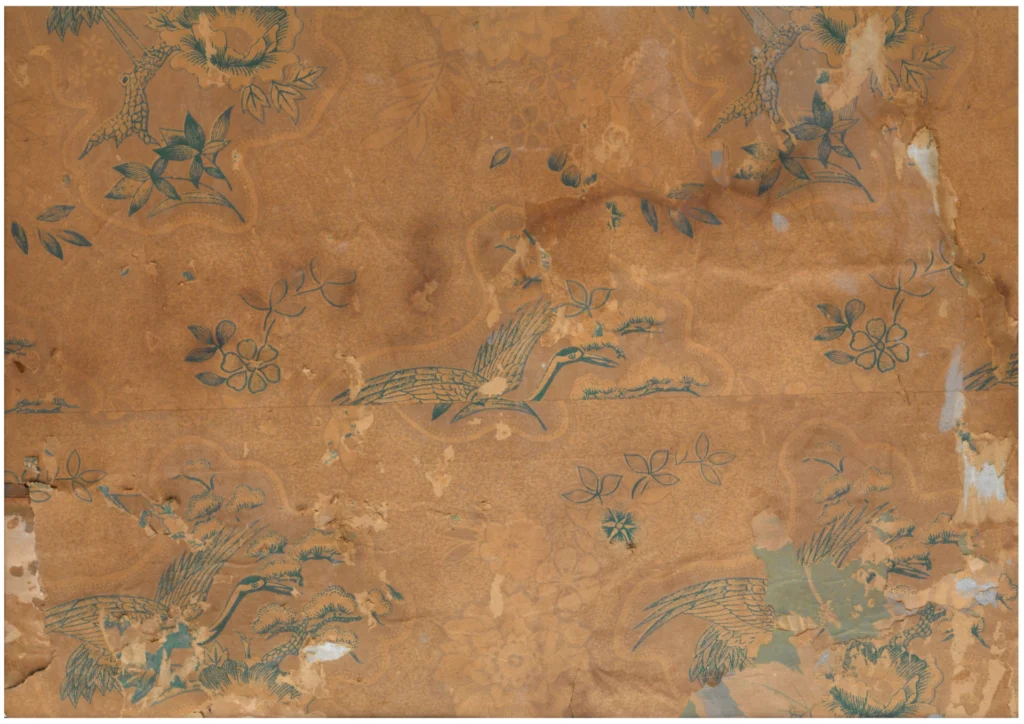
(Source : Gosate Collection)
The fact that this pattern has been found repeatedly across the country speaks to the unrivaled status this wallpaper occupied in the market of the time. Combining familiar auspicious iconography, the memory of jangji culture, and refined printing technology, this wallpaper achieved a popular reach in the early 1960s that earns it the designation "the national auspicious wallpaper of its era." As a successful transplantation of traditional iconography into a modern print medium, it stands as a precious historical document of the moment when Korean wallpaper design was finding its balance between tradition, modernity, and mass production.
Copyright © 2026 Gosate Archive. All Rights Reserved.
All Rights Reserved.
- All text and scholarly analysis are the intellectual property of the author.
- All photographs marked "Gosate Collection" or "Photo by Gosate" are the copyright of GOSATE. Reproduction, copying, or distribution without prior consent is strictly prohibited.
- Historical images cited from external sources are subject to their respective copyright holders or public domain provisions.
Inquiries: contact@gosate.kr
More from this era