The Little Flowerpot on the Wall: A Korean Translation of the Western Medallion
1. A Western 'Medallion Floral' Layout Built from Repeating Flowerpots The underlying structure of this pattern, found in early 1970s Korean wallpaper, is rooted in the Medallion Floral layout — a form with a…
1. A Western 'Medallion Floral' Layout Built from Repeating Flowerpots
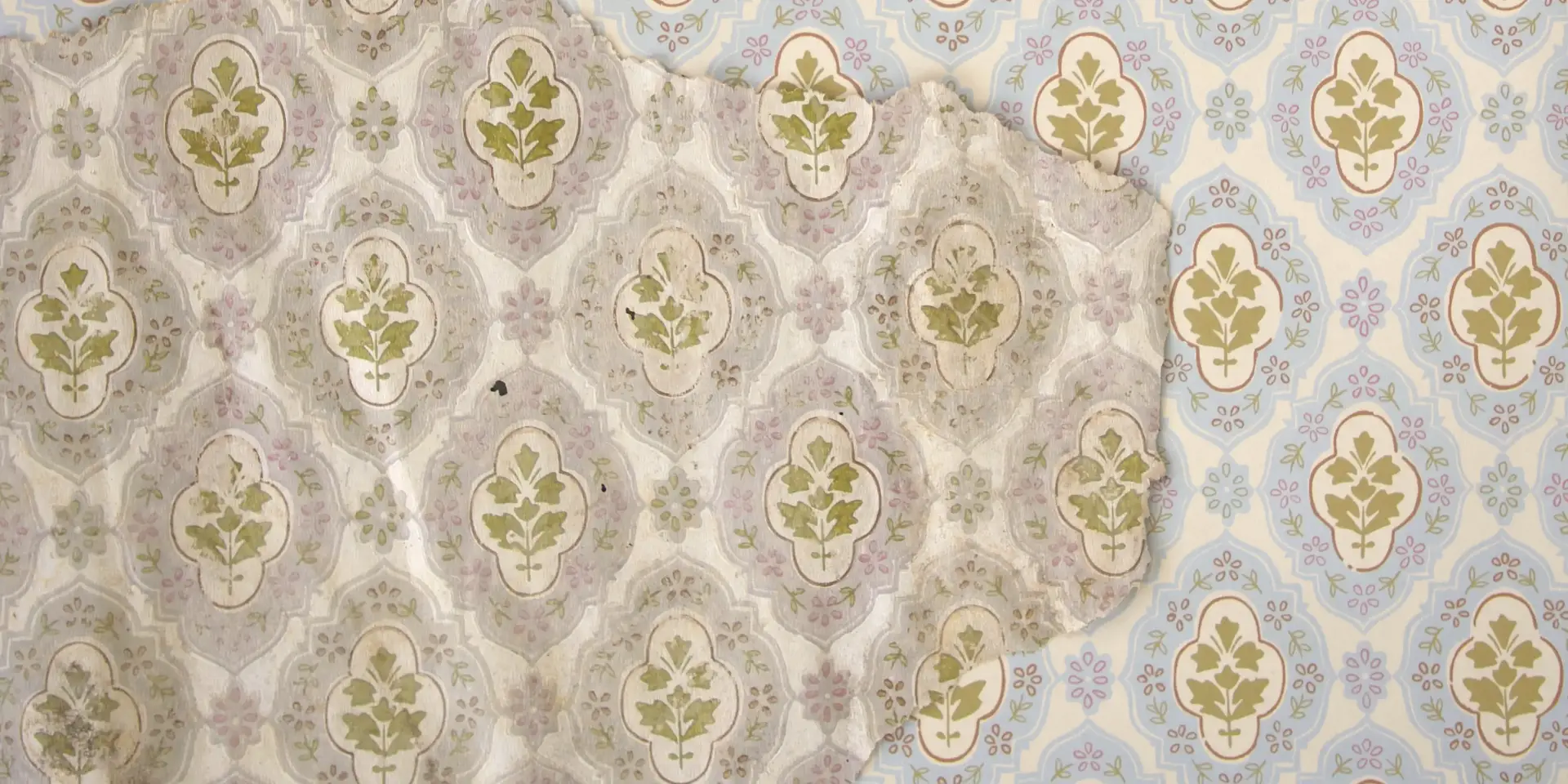
The underlying structure of this pattern, found in early 1970s Korean wallpaper, is rooted in the Medallion Floral layout — a form with a long tradition in the history of Western decorative arts. A small tree-like plant silhouette is placed within an oval cartouche (medallion), and this unit is repeated continuously across a diagonal grid. The spaces between the medallions are filled without gap by small flower clusters and decorative motifs, giving the whole composition the format of a diaper pattern — small units arranged at regular intervals across the surface.
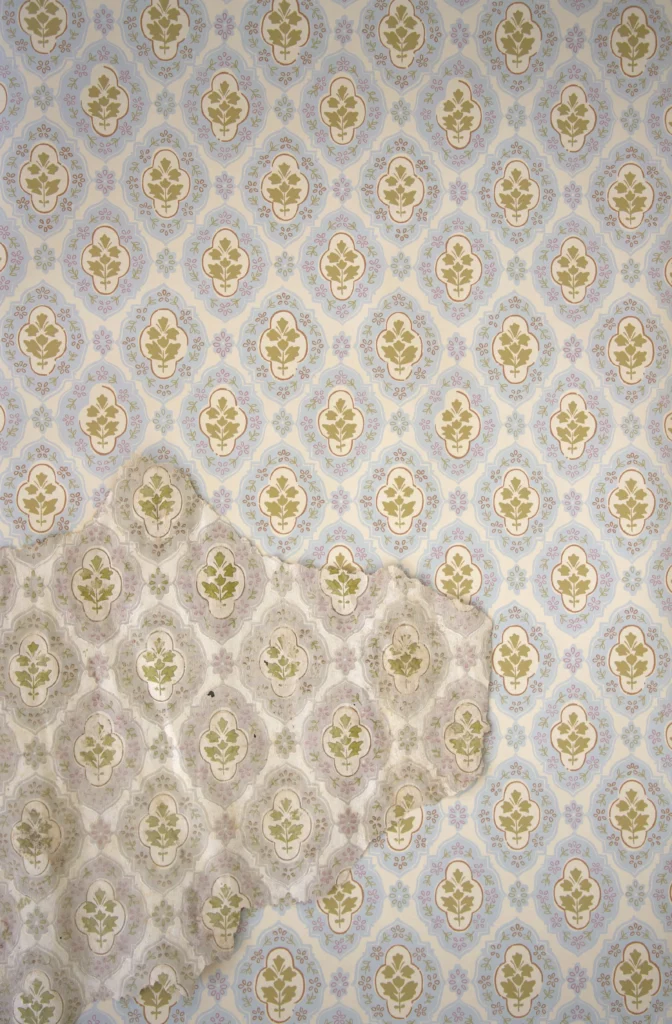
Photo by Gosate 2025)
This structure was a standard formula widely used in 18th–19th century Europe for bedrooms, women's rooms, and children's chambers. — the defining domestic pattern type that covered the entire surface uniformly and calmly with something small and charming. The lineage continued into the 1950s–60s Western catalogue wallpapers, rendered in pastel variations. The small flowerpot motif we encounter today in old Korean homes is, in this sense, a distant relative of the universal floral wallpaper template that accumulated in Western interior decoration from the 18th century onward.
2. The 1970s Korean Medallion, Translated into a Lavender Palette
While the structural origin is Western, the visual details reflect a sensibility entirely specific to 1970s Korea. The palette — a soft lavender ground with small trees and leaves varying in olive green — creates an atmosphere quite distinct from any Western prototype. The lines framing the medallions are organized into gentle curves rather than bold, heavy outlines. The plants within the medallions read less as the realistic floral bouquets of Western convention and more as the flat silhouettes found in folk painting (minhwa) and traditional embroidery — and the decorative motifs throughout favor the rhythm of line over shading, tending toward a schematized graphic form.
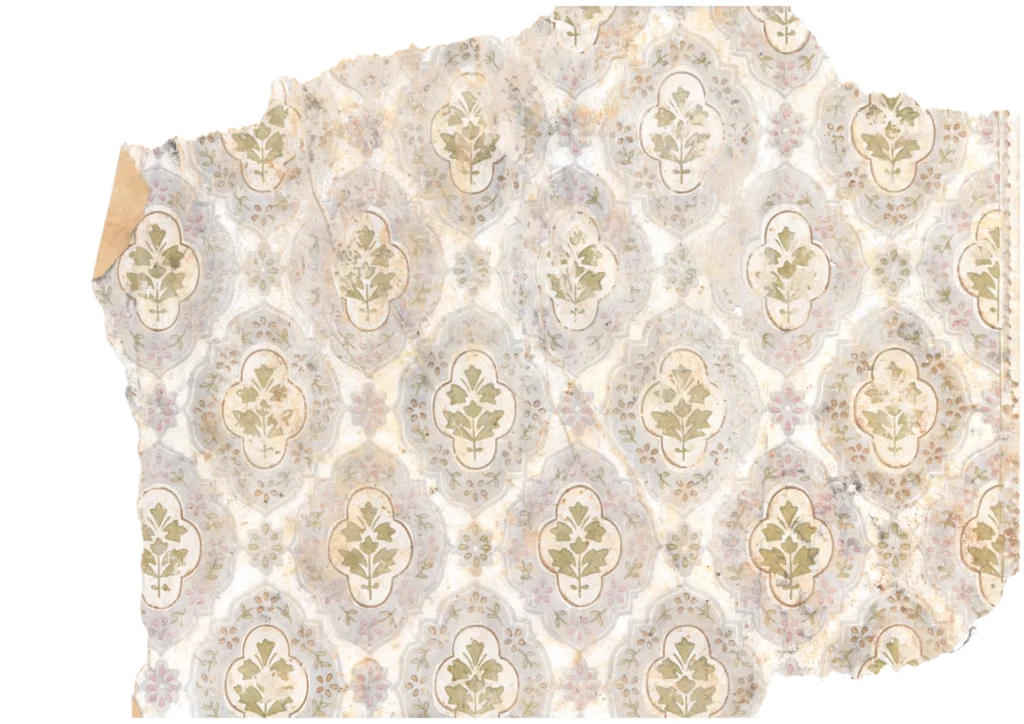
(Source : Gosate Collection)
By layering a Korean pastel palette over the frame of the Western medallion layout, this pattern settled into everyday domestic life — brightening the inner rooms and children's chambers of Korean homes through the 1970s. Where the same layout functioned in Europe as a descendant of Neoclassical interior decoration, in Korea it was reborn as something altogether different: a soft, distinctively local pattern for the mass-produced residential interior.
The wallpapers of the 1970s that follow this form represent what might be called the last generation of "Korean-style Western wallpaper" — those that took the Western layout as their structural skeleton while adapting color and detail to the conditions and preferences of Korean domestic life. They belong to the period just before the era of simple copying that arrived when foreign designs began to be imported directly — a time when independent interpretation and translation were still alive. These wallpapers are a precious record of that moment.
Copyright © 2026 Gosate Archive. All Rights Reserved.
All Rights Reserved.
- All text and scholarly analysis are the intellectual property of the author.
- All photographs marked "Gosate Collection" or "Photo by Gosate" are the copyright of GOSATE. Reproduction, copying, or distribution without prior consent is strictly prohibited.
- Historical images cited from external sources are subject to their respective copyright holders or public domain provisions.
Inquiries: contact@gosate.kr
More from this era