
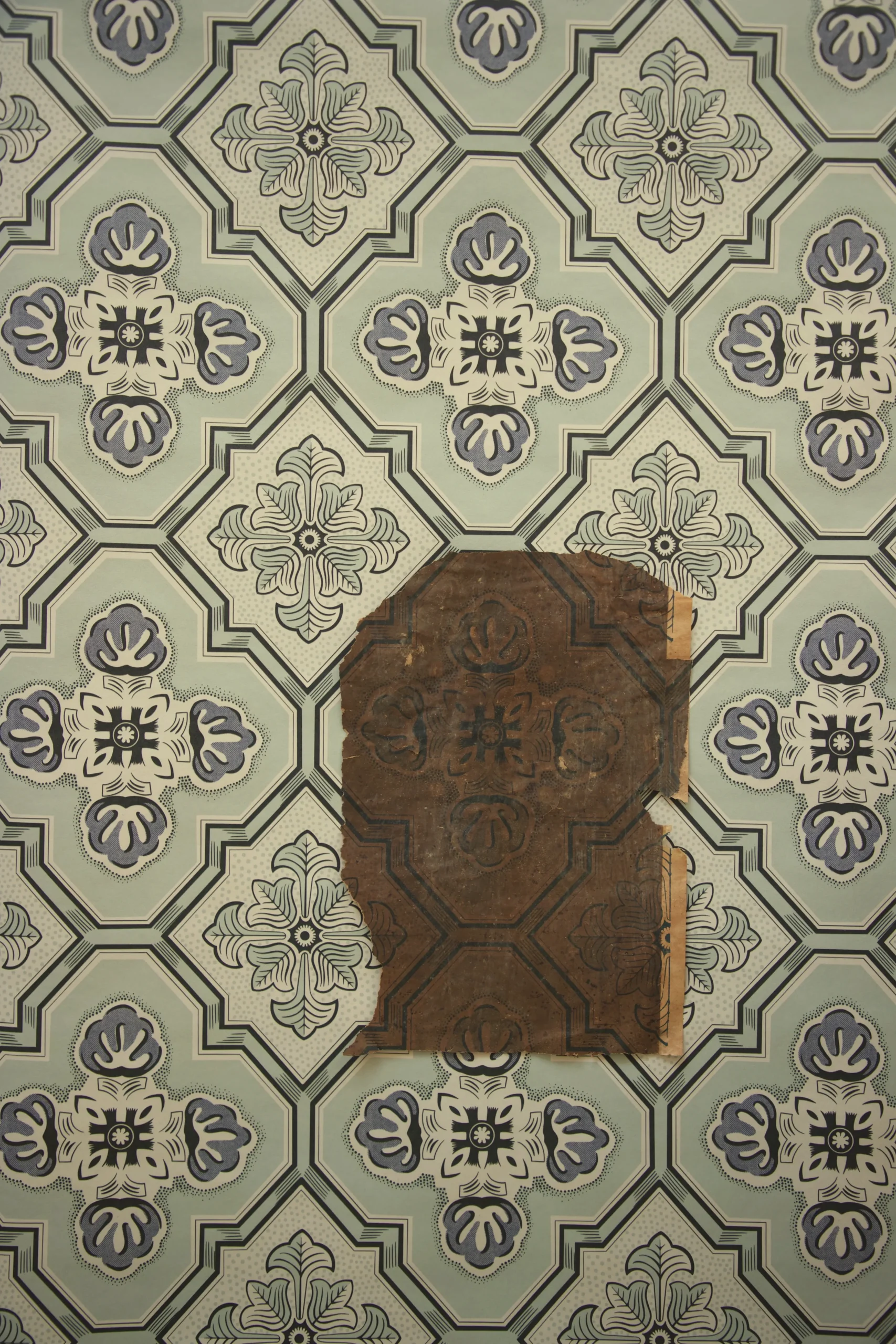
1960s Korean Vintage Wallpaper — Sungsu (original)
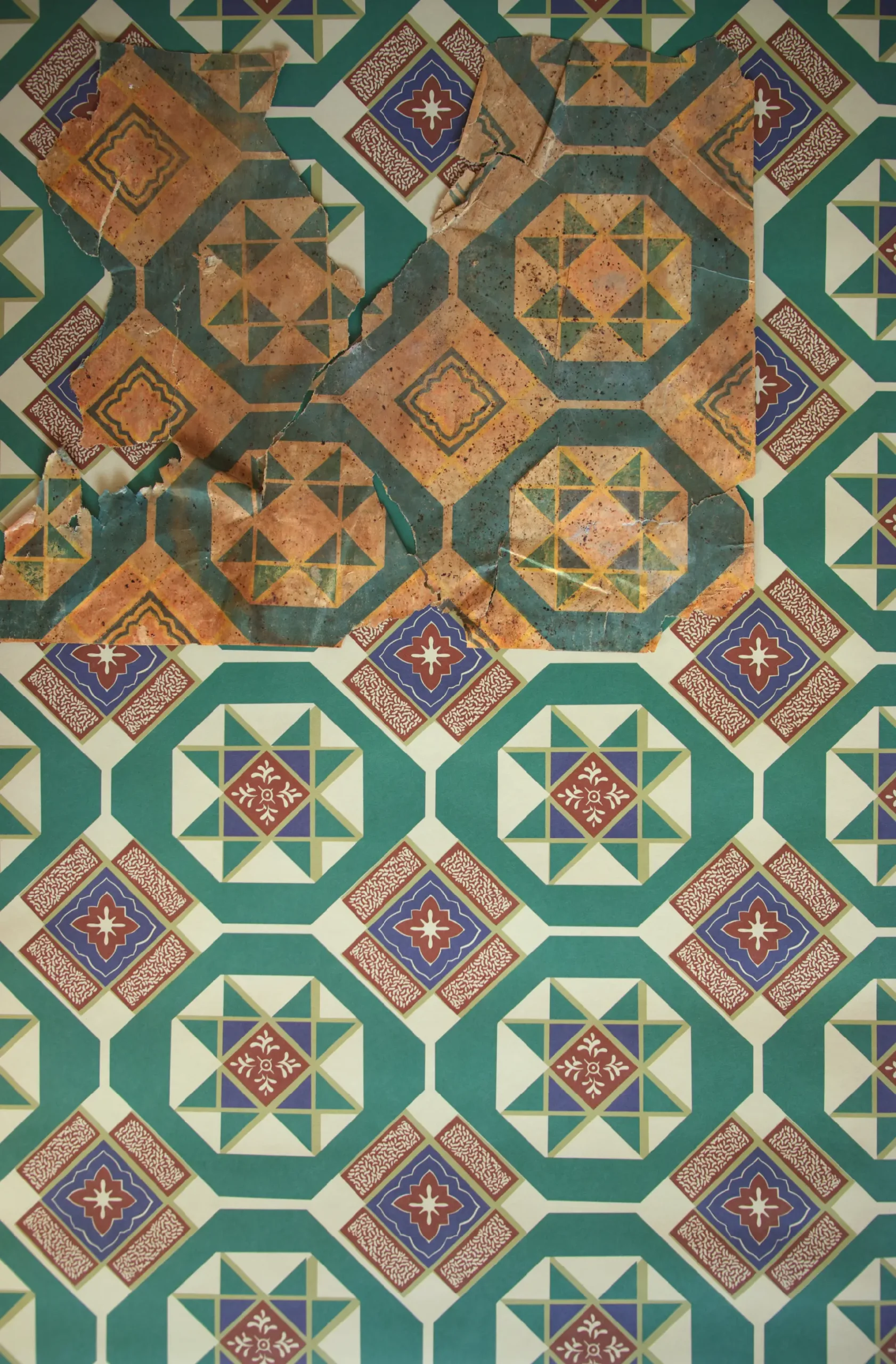
Sungsu was discovered in an 1893 hanok in Boseong County, South Jeolla Province, and dates to the early 1960s. It is a ceiling paper. Its basic unit is an octagonal tile — octagons tessellating in a grid with square blocks at the intersections, a structure that reads from below as a monoleum or stone floor lifted to the ceiling. The defining feature is the step frame: the border of each octagon is not a single line but a three-stage inward staircase, rendered with lines of varying weight to generate shadow and the illusion of beveled depth. Fine stippling fills the interior surfaces, making smooth paper read as rough stone or glazed enamel. The central motif — a four-leaf form with parallel-line shading and carved-looking tips — is less a botanical reference than a Gothic or Renaissance quatrefoil and acanthus reduced to their geometric minimum: not a flower but the graphic memory of carved stone ornament. The overall pattern achieves what might be called architectural neutrality. By replacing the soft curves of a floral with the hard grid of a tile, Sungsu escapes the conventions of the bedroom wallpaper and becomes usable in any room — living rooms, shop interiors, corridors, kitchens — wherever a modern, functional finish was desired. This was a deliberate quality in 1960s Korea, as homes and commercial spaces alike sought an interior language that felt contemporary rather than decorative. The printing quality — fine contour lines, stipple gradations — continues the technical standard of pre-war Japanese imported wallpaper, now produced domestically. GOSATE's reproduction digitally restores the original pattern, printed on premium non-woven base paper manufactured in Sweden. Roll size : 50cm by 10M Material : Non-woven paper Made in Sweden, Design in Korea
Price range: $5.00 through $163.00 (VAT 포함)
Reviews