
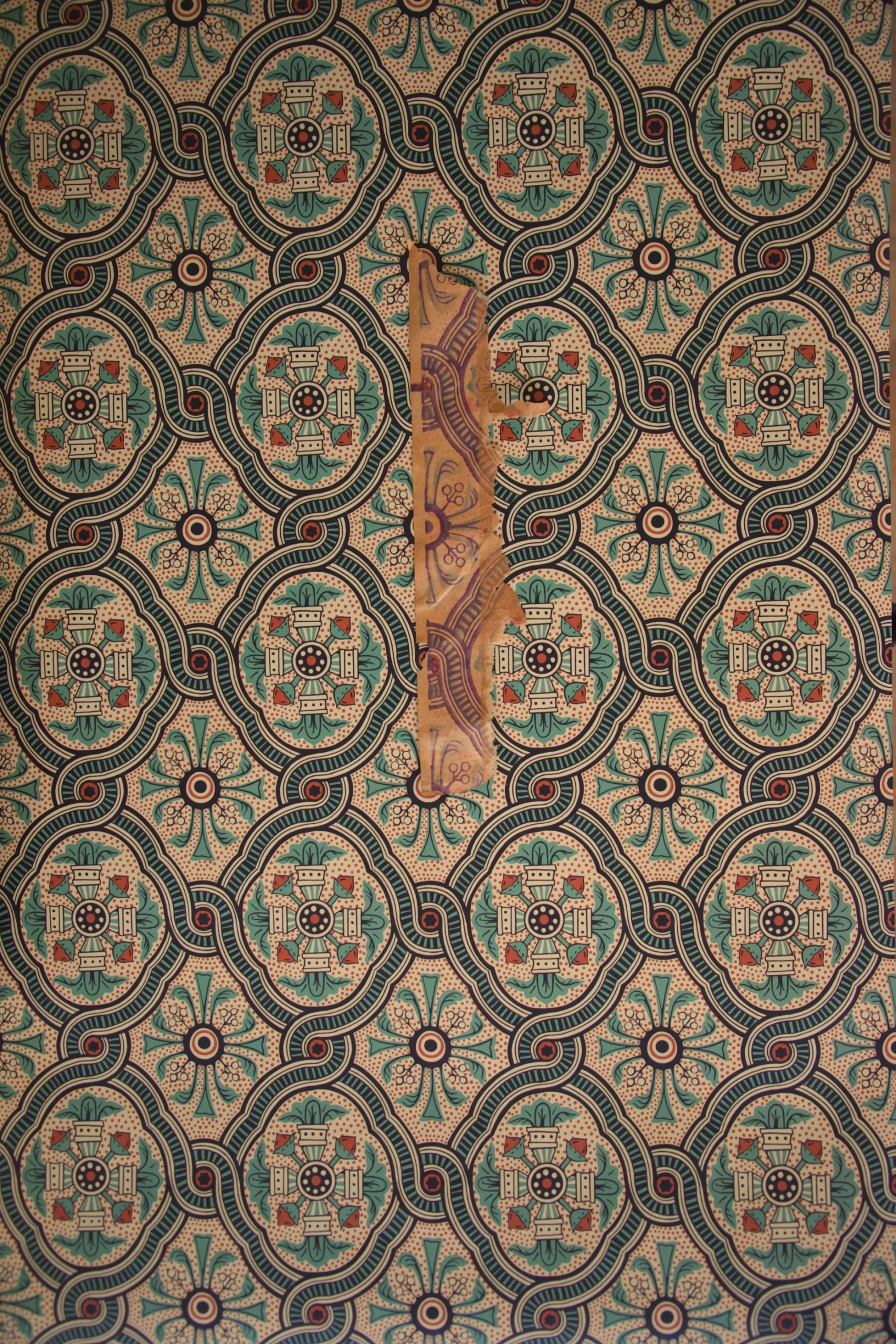
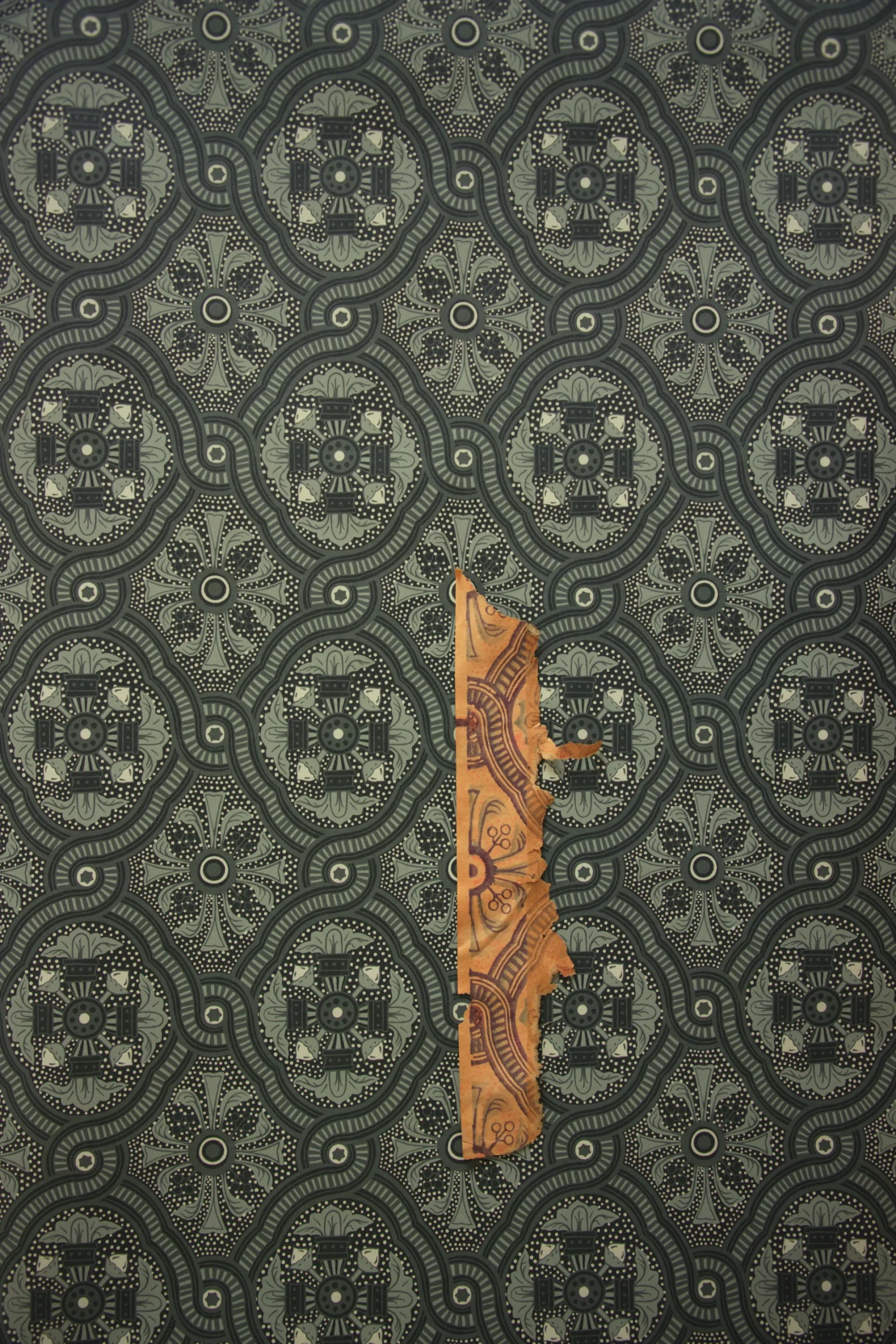
1950s Korean Vintage Wallpaper — Mijung (original / Mineral)
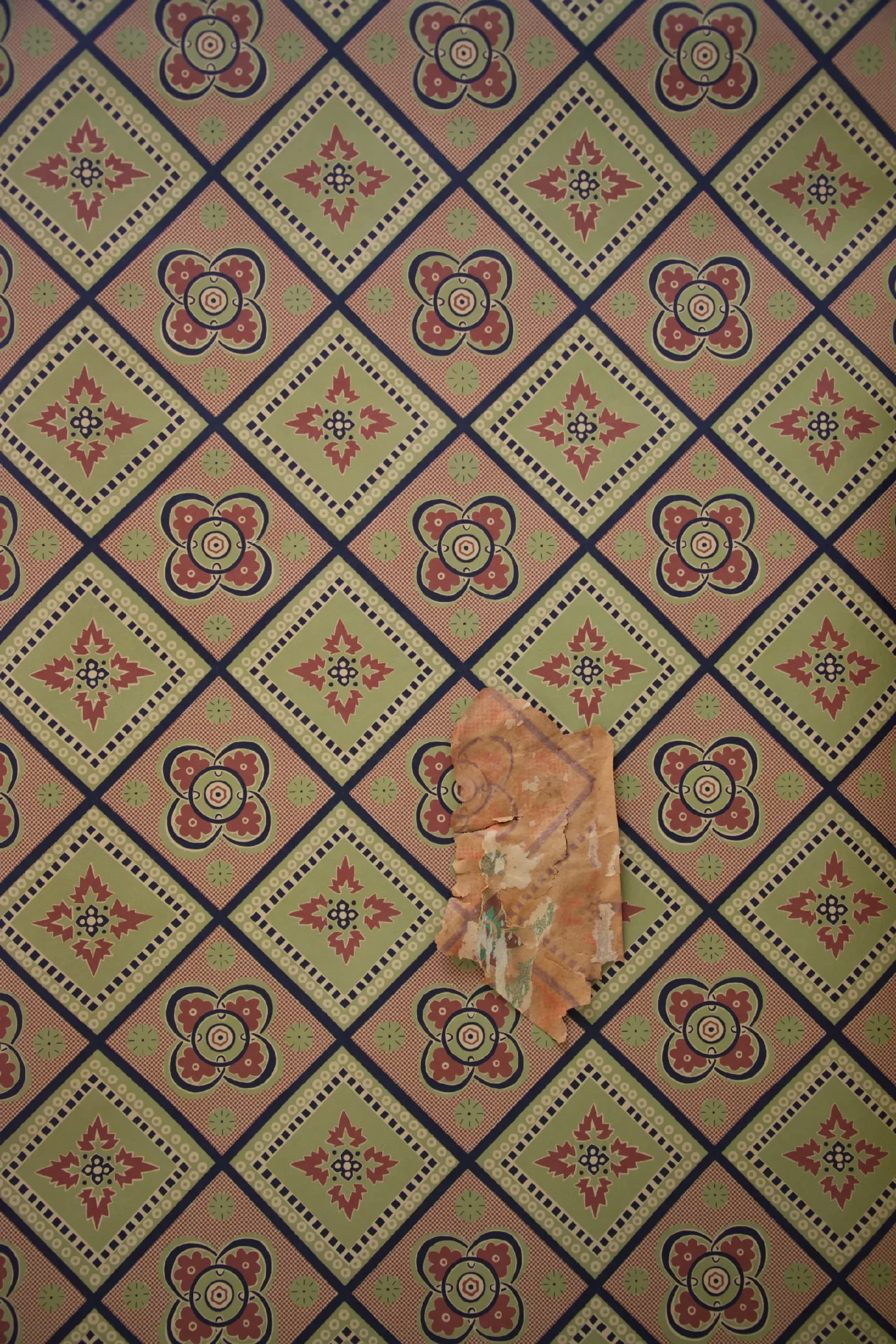
Mijung was found in a 1945 house in Heungwang-ri, Hwado-myeon, Ganghwa Island (now Manisanbang), and dates to the early 1960s. Its defining element is the guilloche — a thick undulating wave line that functions less as decoration than as grout, binding oval and octagonal medallions into a vast grid. Each medallion is built in three concentric layers: an outer band, a middle band, and an inner disc. This tripartite structure is the standard grammar of ancient Mediterranean mosaic work, where the same form framed mythological scenes in Roman villas and adorned Byzantine church floors for centuries. The red stippling that fills the spaces between medallions deepens the illusion: up close it reads as ink dots; from a distance it resolves into the grain of stone or the texture of embroidered cloth. Guilloche medallions of this kind are almost entirely absent from Western European and American wallpaper of the same period — a quiet but significant clue to the pattern's route. The Byzantine visual tradition was carried forward not by Western Europe but by the Russian Orthodox Church, in whose cathedral frescoes, icons, and decorative textiles the same knotted-wave medallion continued to appear. GOSATE's hypothesis is that the pattern reached Korea via Manchuria: the Japanese-administered Manchukuo state shared a long border with the Soviet Union, and its cities — especially Harbin — hosted large Russian émigré communities and Orthodox churches. A Japanese wallpaper manufacturer supplying both the Manchurian and Korean markets may have drawn on this eastern decorative tradition, sending the same design sheets north and south simultaneously. Look closely at the medallion centers and a second history appears: a five-pointed star, gear-like rosettes, and target-circle forms whose mechanical precision echoes the military insignia and industrial imagery that saturated daily life under wartime mobilization. No designer likely set out to print the war onto domestic walls — but the visual language most familiar to anyone living through the 1940s was the language of factories, ranks, and ordnance, and it found its way in. GOSATE's reproduction digitally restores the original pattern, printed on premium non-woven base paper manufactured in Sweden. Available in two colorways: Original and Mineral. Roll size : 50cm by 10M Material : Non-woven paper Made in Sweden, Design in Korea
Price range: $5.00 through $163.00 (VAT 포함)
Reviews