Diamonds and Blossoms — A Shared East Asian Motif and Its Korean Home
Visual Observations This wallpaper is a gupdori-ji (下部帶壁紙) — the paper band that wrapped the lower portion of a hanok's interior walls — likely made between the mid-1940s and the 1950s. Its structure is…

Visual Observations
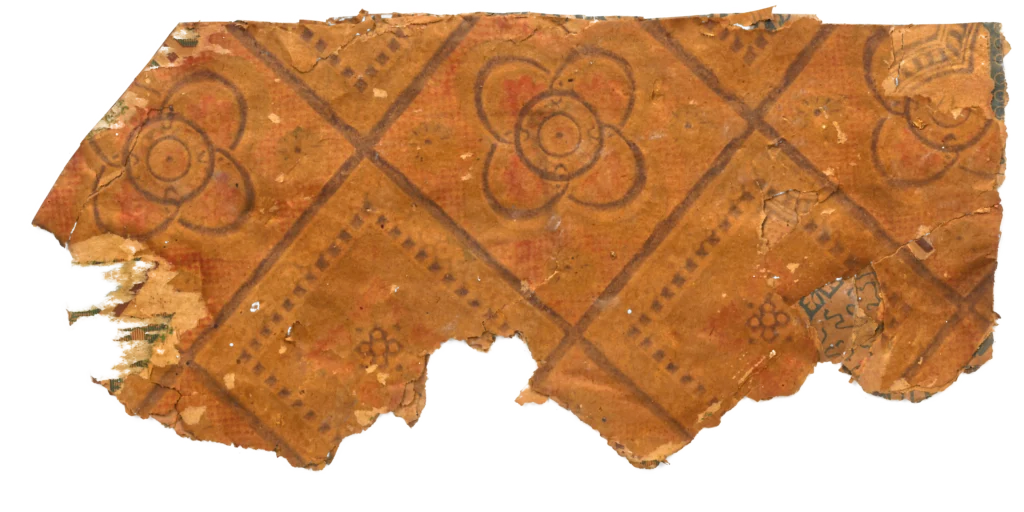
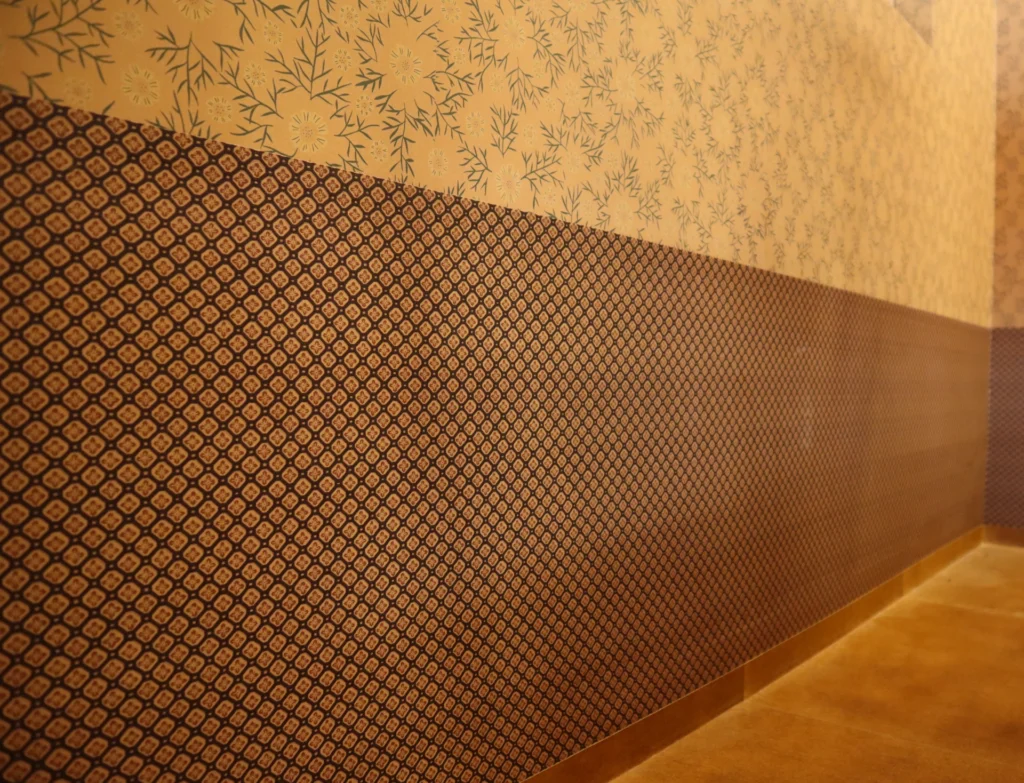
This wallpaper is a gupdori-ji (下部帶壁紙) — the paper band that wrapped the lower portion of a hanok’s interior walls — likely made between the mid-1940s and the 1950s. Its structure is unmistakable: a two-color print of a black-ink diamond lattice filled with small colored flowers. In this particular example the flowers are a deep reddish-brown, but wallpapers in this family have carried the same design with the flowers rendered in green, blue, red, and other colors — an all-over repeat (sabang-yeonsok, 四方連續) in which the lattice stays constant and only the color of the flowers inside it changes.
Each cell formed by the diamond lattice is neatly clipped to an octagon, and a small square dot sits at every point where the lattice lines cross. Inside each cell rests a single simple flower with four or five petals. This structure goes by two names.
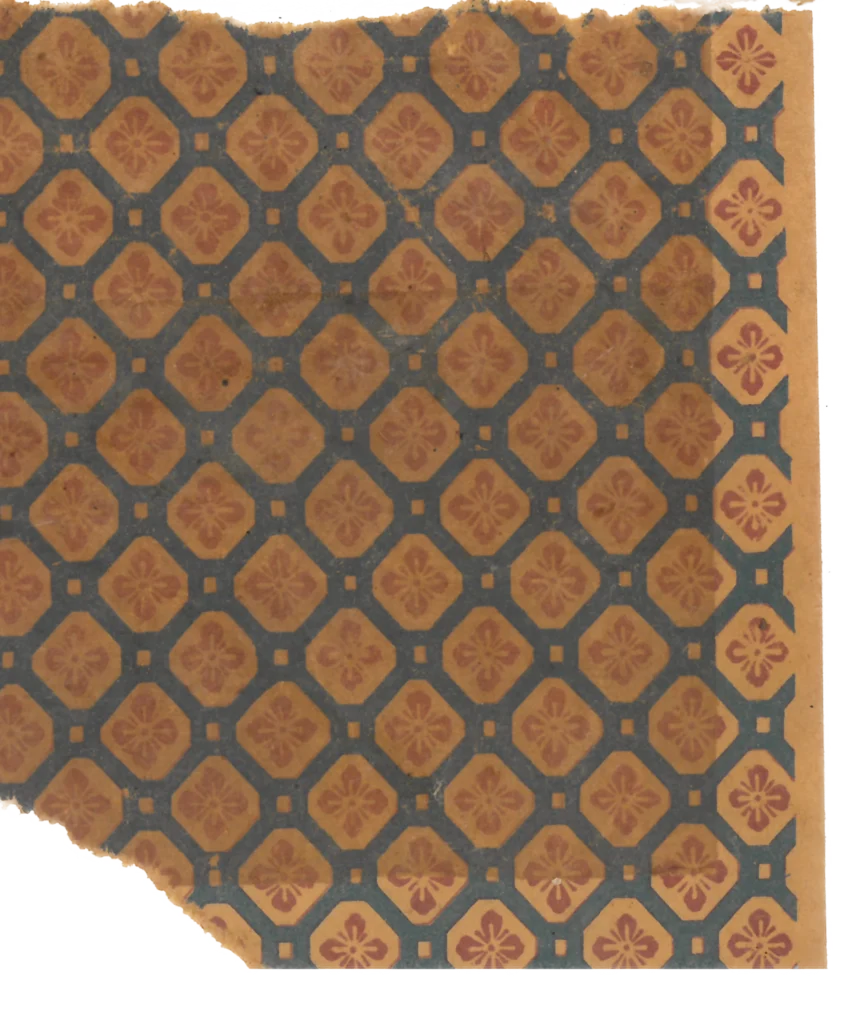
(Source: Gosate Collection)
Two Names — Neunghwa (菱花) and Hanabishi (花菱)
In Korea, this pattern is called neunghwa-mun (菱花紋). Neung (菱) refers to the water caltrop and the diamond shape of its leaves; hwa (花) is the flower placed inside. In Japan, the same design is known as hanabishi (花菱). The two names simply reverse the order of the characters, but they point to the same idea — a lattice of diamonds with a flower set inside each one.
The resemblance is no accident. Through the 18th and 19th centuries, Joseon Korea and Japan actively traded the small motifs used on paper and textiles, and Korean neunghwa paper and Japanese hanabishi weaving developed alongside one another, each refining the other’s vocabulary. Trying to decide which came first, or whom it “belonged” to, is not a particularly useful exercise. The idea of setting a flower inside a diamond is too simple and too universal to belong to any single culture, and it is precisely that simplicity that let it travel so easily between the visual vocabularies of both.
Neunghwa-pan and Neunghwa-ji — How the Pattern Settled onto Paper
Looking at how this shared design was actually used in Korea reveals another layer. In Joseon-era Korea, neunghwa was above all the signature background motif of book covers. A dedicated wooden block was carved specifically to press the design into paper: the neunghwa-pan (菱花板).
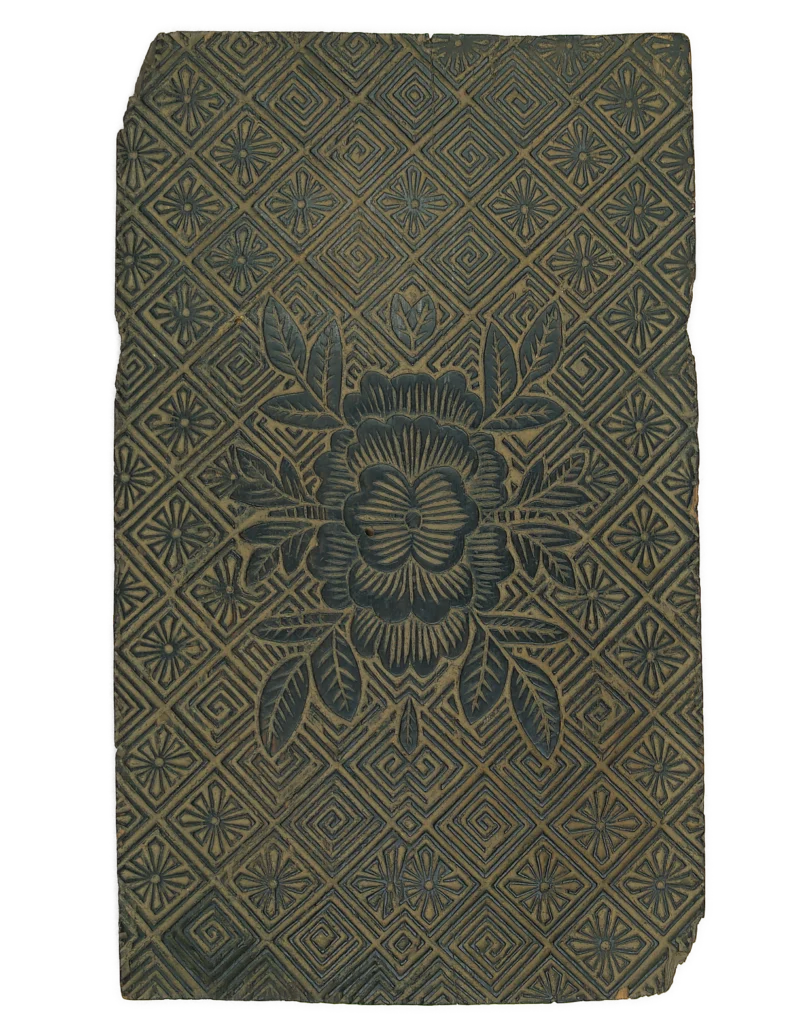
The paper pressed with a neunghwa-pan was itself called neunghwa-ji. The process began with hwang-yeom-ji (黃染紙) — hanji dyed yellow — which was pressed against the block and then coated with wax to give it a soft sheen and, at the same time, a measure of moisture resistance. Books bound in neunghwa-ji covers were beautiful and durable, and their pages were shielded from damp and insects. When the neunghwa-pan first came into use is not precisely known, though it is thought to reach back at least to the late Goryeo period, and it went on to become part of the material scaffolding of book culture throughout the Joseon dynasty.
From Book to Wall — The Places the Pattern Came to Rest
What makes neunghwa particularly interesting is that it never stayed confined to book covers. The same design — or close variations on it — spread across nearly every paper and textile surface in the Korean home. Book covers (neunghwa-ji), the paper linings on furniture (ssabareum), gupdori-ji, the mountings of paintings and calligraphy (janghwang, 粧䌙), the inside and outside of chests and boxes — it is harder to find a paper surface without some form of neunghwa than one with it. That variants of this pattern turn up in hanok across every region of the country tells us something important: it was part of the common grammar of Korean domestic life.
The Place Called Gupdori-ji
The lower wall is the part of a room most often brushed against and most easily soiled. Rather than leaving it in a flat color, using a bold diamond lattice lets wear and stains dissolve into the pattern — a practical choice — while the weight of the black grid anchors the lower wall and sets up a natural hierarchy with the lighter paper above. Just as a book cover protects its pages, gupdori-ji protects the lower reaches of a room, visually and physically. That neunghwa migrated from book cover to lower-wall paper is no accident; it is the same grammar reappearing wherever the same job needs doing.
In the pattern the two countries came to share, the lattice is black and firm while the flower inside it is light and free to change color. An East Asian diamond flower found its way onto the lower wall of one hanok, where it now keeps its quiet watch over one corner of the room.
Copyright © 2026 Gosate Archive.
All Rights Reserved.
- All text and scholarly analysis are the intellectual property of the author.
- All photographs marked “Gosate Collection” or “Photo by Gosate” are the copyright of GOSATE. Reproduction, copying, or distribution without prior consent is strictly prohibited.
- Historical images cited from external sources are subject to their respective copyright holders or public domain provisions.
Inquiries: contact@gosate.kr
More from this era